8 Best Thickness Planers (October 2026)
The best thickness planers include the DeWalt DW735X 13-Inch Thickness Planer for regular lumber prep, the DeWalt DW734 12.5-Inch Benchtop Planer for long board projects, and the WEN PL1326 13-Inch Spiral Planer for blade maintenance flexibility.
On this page (9 sections)
- How we chose these thickness planers
- Compare the best thickness planers
- Best thickness planers by use
- What makes the best thickness planer for your projects?
- How should you set up a thickness planer?
- How do you get consistent boards without wasting lumber?
- Which planer mistakes cause avoidable problems?
- How should you care for a benchtop planer?
- Which best thickness planer pick should you bring home?
The DeWalt DW735X is the best thickness planer for most home shops, especially if you prepare rough lumber regularly and want control over finishing passes. Choose the WEN PL1326 for small, rotatable blades or the DeWalt DW734 for long tables and a simpler feed setup.
A planer earns its place by bringing boards to matching thicknesses for furniture, shelving and glue-ups. It needs a flat reference face, enough room for boards to travel and a workable way to collect chips.
If you're building a shop around it, our guide to benchtop workshop machines for a home shop helps you plan that working space.
Our picks at a glance
-
1
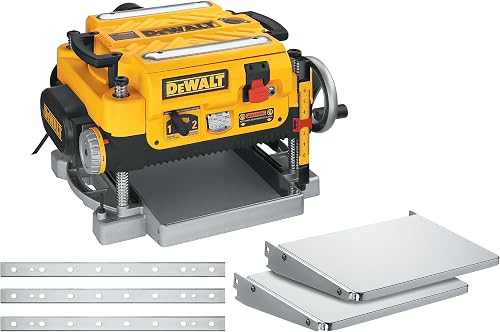 Best for regular lumber prep
DeWalt DW735X 13-Inch Thickness Planer
9.4/10 our score
See it on Amazon -
2
 Best for long board projects
DeWalt DW734 12.5-Inch Benchtop Planer
9.0/10 our score
See it on Amazon -
3
 Best for blade maintenance flexibility
WEN PL1326 13-Inch Spiral Planer
8.9/10 our score
See it on Amazon
- 4
 Check it
Craftsman CMEW320 12.25-Inch Planer
Best for narrow stock projects - 5
 Check it
WEN PL1252 12.5-Inch Two-Blade Planer
Best for occasional batch work - 6
 Check it
VEVOR 13-Inch Planer with Folding Stand
Best for shops without benches - 7
 Check it
VEVOR 13-Inch Two-Blade Planer
Best for existing dust setups - 8
 Check it
VEVOR 13-Inch Three-Blade Planer
Best for varied stock batches
How we chose these thickness planers
We favored useful feed controls, manageable blade care and stock support over headline motor speeds. We compared each machine's capacity, cutterhead, adjustment features, included equipment and dust connection.
The scores reflect those features and their fit for home woodworking. Motor rpm, cutterhead rpm and cuts per minute describe different things, so they aren't interchangeable measures of performance.
We also considered what a buyer must add before starting. A stand, suitable hoses and long-board supports can matter more to your working setup than a small difference in cutting width.
Compare the best thickness planers
The DW735X offers the most balanced feature set here, while the DW734 and PL1326 provide clear alternatives for different priorities. Start with the capacity your projects require, then compare blade care and feed control.
| Product | Best for | Cutting width | Cutterhead | Feed choices | Our score |
|---|---|---|---|---|---|
| DeWalt DW735X 13-Inch Thickness Planer | regular lumber prep | 13 in | Three knives | 96 or 179 CPI | 9.4 |
| DeWalt DW734 12.5-Inch Benchtop Planer | long board projects | 12.5 in | Three knives | 9.0 | |
| WEN PL1326 13-Inch Spiral Planer | blade maintenance flexibility | 13 in | 26 staggered HSS blades | 8.9 | |
| Craftsman CMEW320 12.25-Inch Planer | narrow stock projects | 12.25 in | Two knives | 8.6 | |
| WEN PL1252 12.5-Inch Two-Blade Planer | occasional batch work | 12.5 in | Two reversible blades | 8.0 | |
| VEVOR 13-Inch Planer with Folding Stand | shops without benches | 13 in | 7.6 | ||
| VEVOR 13-Inch Two-Blade Planer | existing dust setups | 13 in | Two HSS blades | 7.2 | |
| VEVOR 13-Inch Three-Blade Planer | varied stock batches | 13 in | Three knives | 15 or 24 ft/min | 7.0 |
Best thickness planers by use
Choose the DW735X for frequent lumber preparation and consider the other picks when their particular setup fits your work better. Each recommendation below includes a reason to choose it and a reason to move on.
DeWalt DW735X 13-Inch Thickness Planer: Best for regular lumber prep
- 13 in cutting width
- Three-knife cutterhead
- Feed settings for 96 or 179 CPI
- Fan-assisted chip ejection
Choose it for frequent stock preparation when you want separate roughing and finishing settings, included tables and spare knives.
Pros
- Two feed choices
- Automatic carriage lock
- Includes tables and an extra set of knives
Cons
- 102 lb weight needs a planned location
- Chip exhaust needs a suitable collection setup
The DW735X suits a shop that mills lumber regularly rather than a bench cleared only for an occasional project. Its 13 in capacity and three-knife head cover a useful range of furniture stock.
The two feed settings produce 96 or 179 cuts per inch. That gives you a choice between quicker progress and more cuts along the board during a finishing pass.
An automatic carriage lock reduces movement associated with snipe, and a turret depth stop helps you return to common thicknesses. The included tables and spare knives make this a more complete starting package.
Fan-assisted chip ejection makes exhaust planning part of the setup. Arrange the hose so it stays clear of exiting stock and routes chips into suitable collection equipment.
Skip it if you must lift the planer onto a bench every session. At 102 lb, it makes more sense in a permanent position or on a suitable mobile stand.
Our DW734 vs DW735 comparison helps you decide whether the extra feed control fits your projects.
DeWalt DW734 12.5-Inch Benchtop Planer: Best for long board projects
- 12.5 in cutting width
- Three-knife cutterhead
- 33.5 in material support
- Four-column carriage lock
Long tables, a carriage lock and a turret depth stop suit furniture projects that need supported feeding and repeat thickness settings.
Pros
- Long infeed and outfeed tables
- Reversible knives
- Material removal gauge and turret depth stop
Cons
- One feed setting
- Less width capacity than the 13 in models
The DW734 suits furniture builders working with long rails, shelves and frame parts. Its tables provide 33.5 in of material support, though long boards still need support beyond the machine.
A four-column carriage lock addresses cutterhead movement, while reversible knives give you another cutting edge before replacement. The material removal gauge helps you judge the bite before feeding a board.
Its turret stop is useful when several projects call for the same finished thickness. Use it to return near the setting, then measure the board rather than relying on the scale alone.
Choose it when one feed setting covers your work and your stock fits its capacity. Taking light final passes remains useful even without a separate finishing speed.
Skip it if wide glue-ups regularly need the extra capacity of a larger opening or you specifically want selectable feed rates. The DeWalt DW734 vs DW735 guide compares those tradeoffs directly.
WEN PL1326 13-Inch Spiral Planer: Best for blade maintenance flexibility
- 13 in cutting width
- 26 staggered, rotatable HSS blades
- Material removal gauge
- Adjustable dust port
Its small, rotatable blades suit buyers who prefer servicing individual cutting edges rather than full-width knives.
Pros
- Rotatable cutter blades
- Height-adjustable support tables
- Depth stop and material removal gauge
Cons
- One feed speed
- HSS blades should not be confused with carbide inserts
The WEN PL1326 suits buyers who prefer servicing small cutting edges instead of handling long planer knives. Its spiral cutterhead uses 26 staggered, rotatable HSS blades.
That arrangement gives you a different maintenance routine, not a reason to ignore grain direction or cut depth. Follow WEN's rotation pattern and fastener instructions when an edge needs attention.
The material removal gauge helps you set the first pass, and the depth stop helps with repeat work. Adjustable tables and predrilled mounting holes support a fixed bench or stand setup.
Its single feed rate means you manage difficult grain mainly through board orientation, sharp blades and lighter cuts. Don't choose it expecting a separate slower finishing mode.
Skip it if carbide inserts are a firm requirement. HSS is a different cutting material, and “spiral” doesn't mean every cutterhead uses the same blade type.
Our WEN PL1326 vs DeWalt DW735 comparison explains how blade arrangement and feed choices affect the decision.
Craftsman CMEW320 12.25-Inch Planer: Best for narrow stock projects
- 12.25 in cutting width
- Two-knife cutterhead
- Reversible double-edged knives
- Vacuum port
A straightforward choice for shelves, rails and other stock that fits its narrower capacity, with reversible knives and a vacuum connection.
Pros
- Double-edged reversible knives
- Quick-change cutterhead
- Vacuum port for chip collection
Cons
- Narrowest cutting capacity in this group
- No second feed setting
The Craftsman CMEW320 fits projects built from narrower boards, such as shelf parts, rails and small panels. Its 12.25 in opening is the narrowest here, so check your intended glue-ups before choosing it.
The two-knife head uses double-edged, reversible high carbon steel knives. A quick-change arrangement suits buyers who want a conventional knife system with a second edge available when the first wears.
Its vacuum port gives you a connection point for chip collection. Match the hose and collection equipment to the machine rather than assuming any shop vacuum will handle a long planing session.
Choose it for straightforward dimensioning within its width limit. You can prepare parts to matching thicknesses without needing a wider machine just because one exists.
Skip it if your main goal is processing broad panels or choosing between roughing and finishing feed rates. Our dust collection guide can help you plan collection alongside the rest of your tools.
WEN PL1252 12.5-Inch Two-Blade Planer: Best for occasional batch work
- 12.5 in cutting width
- Two reversible SK5 blades
- Workpiece return rollers
- Height-adjustable support tables
Return rollers and adjustable tables suit hobby projects where several boards need repeated passes at the same settings.
Pros
- Reversible SK5 blades
- Workpiece return rollers
- Predrilled mounting holes
Cons
- One feed rate
- Less width capacity than the 13 in options
The WEN PL1252 suits occasional batches of boards that need repeated passes. Workpiece return rollers help move stock back to the starting side without making the cutterhead opening part of that route.
Its two reversible SK5 blades provide another edge when the first pair of cutting edges wears. Keep a compatible replacement set available if a damaged blade would stop an entire project.
Height-adjustable tables let you align the entry and exit support. Predrilled base holes make it possible to secure the planer to a suitable work surface instead of relying on its weight.
Choose it when a conventional two-blade system meets your needs and you don't need a second feed rate. Its 12.5 in capacity covers individual boards and some modest glue-ups.
Skip it if wide panels or selectable feed control drive the purchase. Before processing a batch, follow our guide to using a thickness planer and establish your reference face and target thickness.
VEVOR 13-Inch Planer with Folding Stand: Best for shops without benches
- 13 in cutting width
- Foldable extension plates
- Detachable stand
- Dust exhaust interface
The included stand gives the planer its own working location when your bench is already occupied.
Pros
- Stand included
- Foldable extension plates
- Metal workpiece return rollers
Cons
- Stand needs clear floor space
- Two-blade head without selectable feed speeds
The VEVOR stand-equipped planer suits a shop with floor space but no spare bench. Its included detachable stand gives the machine a working location without first building a separate base.
Foldable extension plates help reduce its stored footprint. Leave enough room to deploy them fully and pass a board through without striking walls, shelves or nearby tools.
The cutterhead uses two HSS blades, and metal return rollers help with repeated passes. A crank handle adjusts height, while the scale gives a starting reference for thickness.
The dust exhaust interface needs a suitable connection before routine use. The included dust cover doesn't perform the job of a collector that removes chips from the machine.
Choose this package because you need the stand, after checking its fit in your shop. Skip it if you already have a suitable workstation and would get more use from selectable feed settings or a different cutterhead arrangement.
VEVOR 13-Inch Two-Blade Planer: Best for existing dust setups
- 13 in cutting width
- Dual-roller feed system
- Two HSS blades
- 2 in and 4 in hose compatibility
Two dust hose size options make this worth considering when matching a planer to equipment already in your shop.
Pros
- Two dust hose size options
- Dual-roller feeding
- 28.2 in worktable length
Cons
- One feed speed
- Vacuum and dust bag sold separately
The VEVOR two-blade planer suits buyers matching a machine to an existing dust system. Compatibility with 2 in and 4 in hoses gives you two connection sizes to work around.
Check the actual hose cuffs and adapter fit before arranging the bench. A nominal hose size doesn't mean every fitting joins tightly without an adapter.
Its dual-roller feed system advances stock across a 28.2 in worktable. That support helps at the machine, but a long board still needs a level path beyond both ends.
The two HSS blades and single feed setting make this a conventional choice for bringing boards to thickness. Use smaller cuts as the stock gets wider or the grain becomes harder to cut cleanly.
Skip it if you need collection equipment included, since the vacuum and dust bag are separate. Choose it only after confirming that its hose options solve a real setup need in your shop.
VEVOR 13-Inch Three-Blade Planer: Best for varied stock batches
- 13 in cutting width
- Three-knife cutterhead
- Two feed speeds
- 35 in total table length
Selectable feed rates and extended tables suit buyers who switch between bringing boards to thickness and making lighter finishing passes.
Pros
- Two feed speeds
- Material removal gauge
- Extended table support
Cons
- Extensions need clear operating space
- Long boards still need separate support
The VEVOR three-blade planer suits buyers who want separate feed choices for different stages of a batch. Its 15 and 24 ft/min settings let you switch between slower finishing work and quicker thickness reduction.
Extended tables provide 35 in of total support. That can help with entry and exit control, but it doesn't remove the need for separate supports under long or heavy stock.
A material removal gauge helps you assess each pass, while the thickness scale gives a repeatable starting point. Measure your boards as you approach the finished size.
The vacuum port provides a route for chips, and the machine includes over-current protection. If protection trips, stop and resolve the load or setup issue before restarting.
Skip it if you don't need the second feed setting or can't leave room for the extensions. Before buying any planer to flatten warped lumber, read what a jointer is used for so you choose the right first machine.
What makes the best thickness planer for your projects?
The best choice fits your widest stock, maintenance routine and available working space. Start with the boards you intend to make, then decide which features will save useful effort.
Choose the best thickness planer width for your stock
Measure the widest piece you expect to feed, including glued panels. These machines span 12.25 to 13 in, so a small capacity difference can decide whether a particular panel fits.
For larger tabletops, plane individual boards before glue-up and use another method to level the assembled surface. Don't buy a benchtop planer expecting it to handle panels wider than its opening.
Match the cutterhead to the care you will do
Long reversible knives give you another edge before replacement. Small rotatable blades change the service task, especially when damage affects only part of a cutting edge.
Confirm replacement blade compatibility before buying, and read the change procedure. A cutterhead is a poor fit if you won't keep its edges sharp or follow its fastening instructions.
Decide whether feed control will earn its place
A slower feed puts more cuts along each inch of board when cutterhead speed stays the same. It can help with a finishing pass, but reversing grain can still tear even with that setting.
One feed rate is enough for many shelf, cabinet and furniture parts. Prioritize a second setting when you expect to switch often between stock reduction and careful final passes.
Budget space for the whole board
The machine's footprint is only part of its space requirement. You need a clear board-length path on both sides, plus room to handle stock and route the hose.
Plan for suitable support stands and secure mounting before ordering. Our guide to choosing a thickness planer expands on capacity and shop layout if you're still deciding what belongs on your bench.
How should you set up a thickness planer?
Start with secure mounting, aligned supports and connected chip collection before adjusting cutting depth. A machine that shifts or a board that tips makes consistent thickness harder to achieve.
Mount the planer and align the tables
Use a bench or stand rated for the machine and its work load. Secure the base as directed, and lock any mobile stand before feeding stock.
With power disconnected, check the extension tables using a straightedge and the manual's alignment procedure. Set separate supports to carry long stock without raising it above the intended feed path.
Support stands should also track straight. A roller angled across the board's path can steer the stock sideways as it travels.
Arrange power and chip collection
Follow the manual's circuit and extension-cord requirements. Sharing an already loaded circuit with another demanding tool can interrupt work.
Route the hose away from the board and avoid tight bends that collect chips. Check the collector before a batch, since planing fills containers much faster than light sanding.
A dust port alone doesn't capture debris, and fan-assisted ejection still needs a suitable destination. Our guide to the best dust collectors for a small shop helps you compare collection setups.
Check thickness before making a full batch
Use a suitable scrap board to compare the scale setting with the actual result. Measure at several points with calipers or another suitable gauge.
Treat a depth stop as a return aid rather than a substitute for measurement. Check again after blade work or adjustment, and measure before taking a pass that could leave every part too thin.
How do you get consistent boards without wasting lumber?
Use a flat reference face, light cuts and batch processing to reach a shared thickness. Leave enough material for final cleanup instead of making the first pass do all the work.
Establish a flat face first
A thickness planer cuts the upper face relative to the underside. Feed rollers can press a bowed or cupped board down, then let it spring back after the cut.
Flatten one face with a jointer, a properly built planer sled or another suitable method. Put that reference face on the bed before using the planer to make the opposite face parallel.
Read the grain and inspect the wood
Where grain direction is clear, orient the board so the knives cut with it rather than lifting against it. Figured grain can change direction within one board, so begin with a light cut.
Inspect reused wood for nails, screws, grit, loose knots and other defects. A metal detector helps locate hidden fasteners, but dirty or unsafe stock still needs preparation before entering the machine.
Bring a batch down together
Mark the reference face and target thickness on your project notes. Once boards share a common starting thickness, pass each through at the same setting before lowering the head again.
Measure as you approach the target and reduce the cut for the last passes. Keep track of your thinnest board so a small mistake doesn't force the entire batch below the size your plan requires.
Which planer mistakes cause avoidable problems?
The most costly mistakes are taking too much material, losing board support and feeding unsuitable stock. Correct the cause before trying to compensate with another pass.
Treating maximum cut depth as a routine setting
A maximum cut is a limit under particular conditions, not a starting recommendation. Wide hardwood boards generally call for lighter cuts than narrow, easy-cutting stock.
If feed slows, the motor labors or chips stop clearing, stop and investigate. Repeatedly resetting protection without changing the load can leave the original problem unresolved.
Trying to plane every offcut
Follow the machine's minimum stock length and thickness limits. Short pieces can lose roller control, while thin stock may require an approved carrier method.
Don't feed end-grain cutting boards through these machines. Use a suitable sanding or flattening method, and keep your hands clear of the feed openings.
Chasing snipe without fixing support
Snipe is an unwanted deeper cut near a board's end. Start by checking table alignment, carriage locking and how the stock enters and leaves.
Allow trim length where the project permits, but don't rely on trimming to hide a poor setup. Our guide to preventing planer snipe helps you work through the causes in order.
Expecting a finish-ready surface
A planer's job is dimensioning stock, and shallow cutter marks or small grain defects may remain. Leave a modest allowance for scraping or sanding where your project needs it.
Repeated heavy passes won't cure tearout caused by dull edges. Change the cutting conditions before sacrificing more board thickness.
How should you care for a benchtop planer?
Keep cutting edges sharp, feed surfaces clean and chip paths clear. Disconnect power before maintenance and follow the machine's access and blade-service instructions.
Brush or vacuum loose chips after use, especially around the exhaust connection. Use the manual's approved cleaning method for feed rollers and the bed.
Avoid lubricants that can transfer to lumber or reduce roller grip. Apply rust protection only where appropriate, and keep it away from surfaces the manual says must stay dry.
Raised lines can indicate a nicked edge, while slipping feed may point to dirty rollers or excessive cutting load. Diagnose the pattern before adjusting unrelated parts.
Which best thickness planer pick should you bring home?
Choose the DW735X for frequent milling with selectable feed control, provided you can give it a stable working location. Choose the DW734 when long support tables and a single feed setting match your work, or the PL1326 when you prefer small rotatable blades.
For narrower projects, compare the Craftsman and PL1252 by blade care and board handling. Consider the VEVOR models when the included stand, hose connections or feed settings meet a specific need.
The best thickness planer for your shop is the one you can support, collect chips from and maintain properly. Before the first batch, follow our guide to using a thickness planer and confirm the setup with a suitable scrap board.
Our top 3 picks at a glance
-
1
Best for regular lumber prep
DeWalt DW735X 13-Inch Thickness Planer
9.4/10 our score
See it on Amazon -
2
Best for long board projects
DeWalt DW734 12.5-Inch Benchtop Planer
9.0/10 our score
See it on Amazon -
3
Best for blade maintenance flexibility
WEN PL1326 13-Inch Spiral Planer
8.9/10 our score
See it on Amazon
Frequently asked questions
What does a thickness planer do?
A thickness planer makes a board thinner and its upper face parallel to the face resting on the bed. Start with a flat reference face, made with a jointer, a suitable sled or another flattening method.
Feed rollers can press warped wood flat temporarily, allowing the shape to return afterward.
Is a spiral planer better than a three-knife planer?
A spiral planer is worth choosing when you prefer small, rotatable blades over full-width knives. Cutterhead style alone doesn't decide surface quality; grain direction, sharp edges, feed rate and cut depth matter too.
The WEN PL1326 uses HSS blades, so don't assume it has carbide inserts.
How wide should a benchtop thickness planer be?
Choose enough capacity for the widest board or glued panel you actually need to feed through the machine. These picks range from 12.25 to 13 in, a small difference that can still decide whether a panel fits.
For wider projects, plane individual boards before assembly or use another surfacing method.
How do I reduce snipe on a thickness planer?
Keep stock supported level at both ends, align the extension tables as the manual directs and use the carriage lock when required. Avoid lifting or dropping a board as the feed rollers take over.
Our guide to stopping snipe on a planer explains how to find the cause before changing settings.


