7 Best Dust Collectors for a Small Shop (October 2026)
The best dust collectors for a small woodworking shop include the WEN DC1300 50-Gallon Dust Collector for several machines, the WEN 15-Gallon Dust Collector for changing shop layouts, and the POWERTEC 1 HP Dust Collector with Mobile Base for shared rolling collection.
On this page (8 sections)
- Which dust collector is best for a small shop?
- How do you choose the best dust collector for a small shop?
- Should your collector roll between tools or stay on the wall?
- How should you connect a small-shop dust collector?
- What does filter quality mean for a small woodworking shop?
- How do you keep collection working between projects?
- Which common buying mistakes should you avoid?
- Which dust collector should you choose for a small shop?
The WEN DC1300 50-Gallon Dust Collector is the best dust collector for a small shop with several machines and enough room for a rolling collection station. Its large bag suits chip-heavy work, while smaller mobile and wall-mounted options fit shops where placement matters more.
Choose around your tools, then your layout. A collector parked close to the machine can be more useful than a larger unit connected through a long, cramped hose route.
Plan equipment placement with our small woodworking shop setup guide and shop setup and dust collection guide. If a planer is part of that plan, compare the machines in our best thickness planers guide before choosing the collection point.
Our picks at a glance
-
1

-
2
-
3
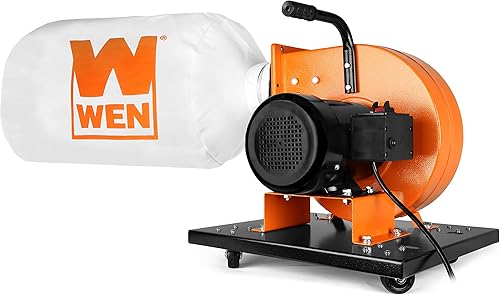
 Best for shared rolling collection
POWERTEC 1 HP Dust Collector with Mobile Base
8.0/10 our score
See it on Amazon
- 4
 Check it
POWERTEC 1 HP Wall-Mount Dust Collector
Best for fixed workstations - 5
 Check it
BUCKTOOL 1 HP Wall-Mount Dust Collector
Best for remote switching - 6
 Check it
BUCKTOOL 1.2 HP 13-Gallon Dust Collector
Best for compatible auto-start tools - 7
 Check it
ShopMax 20-Gallon Dust Collector
Best for varied tool connections
Which dust collector is best for a small shop?
The WEN DC1300 is our first choice for several machines, the smaller WEN suits changing layouts, and the POWERTEC wall-mount model suits a permanent workstation. The right choice depends on whether you need chip capacity, easy movement or clear floor space.
We compared airflow, filtration, connection options and service access for a small woodworking shop. The scores favor useful combinations of those features, rather than motor size alone.
| Product | Best for | Airflow | Collection capacity | Setup | Our score |
|---|---|---|---|---|---|
| WEN DC1300 50-Gallon Dust Collector | several machines | Up to 1,300 CFM | 50 gallons | Mobile base; dual 4 in inlets | 8.8 |
| WEN 15-Gallon Dust Collector | changing shop layouts | Up to 600 CFM | 15 gallons | Mobile base or optional wall mount | 8.1 |
| POWERTEC 1 HP Dust Collector with Mobile Base | shared rolling collection | Up to 800 CFM | Mobile base; 4 in intake port | 8.0 | |
| POWERTEC 1 HP Wall-Mount Dust Collector | fixed workstations | Up to 560 CFM | Wall-mounted; 4 in inlet | 7.8 | |
| BUCKTOOL 1 HP Wall-Mount Dust Collector | remote switching | 550 CFM | Wall-mount bracket or wheels | 7.1 | |
| BUCKTOOL 1.2 HP 13-Gallon Dust Collector | compatible auto-start tools | Up to 750 CFM | Mobile base; 5 ft hose and reducers | 7.0 | |
| ShopMax 20-Gallon Dust Collector | varied tool connections | Up to 677 CFM | 20 gallons | Mobile; five hose adapters | 6.8 |
WEN DC1300 50-Gallon Dust Collector: Best for several machines
- Up to 1,300 CFM
- Two 4 in inlets
- 50-gallon collection bag
- Mobile base with swivel casters
Choose this WEN for a shared collection station serving several machines. Its large bag suits chip-heavy work, provided you can leave space for the base and bag access.
Pros
- Highest stated airflow here
- Two tool connections
- Large collection bag
Cons
- Needs floor space and bag clearance
- Two inlets do not guarantee simultaneous tool capacity
Choose the WEN DC1300 if you want one collector to serve several machines without emptying a small bag after every chip-heavy task. It offers up to 1,300 CFM, dual 4 in inlets and a 50-gallon collection bag.
The four swivel casters let you bring it toward the machine in use. That approach keeps the hose shorter than parking the collector in a distant corner and running flexible hose around the room.
Its two inlets also let you leave two tools connected. Plan to isolate an idle branch with a suitable gate or closure, following the instructions, rather than leaving an unused path open to draw air.
Skip it if its parking space would block stock handling or make bag removal awkward. A large collector loses much of its value if you must move several machines just to empty it.
For most solo shops, treat this as a shared collector serving one running machine at a time. Simultaneous collection needs a separate check of both tools' airflow demands and the full hose system.
WEN 15-Gallon Dust Collector: Best for changing shop layouts
- Up to 600 CFM
- 15-gallon collection bag
- 4 in dust port
- Mobile base and optional wall mount
Rolling and wall-mount options suit a shop whose layout may change. Its single inlet works best with a short connection to the machine in use.
Pros
- Mobile or wall-mounted placement
- Onboard carrying handle
- Zippered collection bag
Cons
- Smaller bag needs more frequent emptying
- Single tool inlet
The smaller WEN fits a shop where you haven't settled on a permanent collection spot. Its mobile base and optional wall mounting let you start with a rolling setup and choose a fixed location later.
It moves up to 600 CFM through a single 4 in port and uses a 15-gallon, 5-micron zippered bag. This is a straightforward choice for connecting the machine you're using, then switching the hose when the next task begins.
At 43.3 x 17.7 x 20.1 in and 41.1 lb, it still needs a measured parking space. The carrying handle helps with positioning, but plan a rolling route rather than routine lifting.
Choose it for shorter sessions and a shop that changes between woodworking and other uses. Skip it for long runs of heavy chip production if frequent emptying would interrupt your work.
Before committing to a wall location, arrange the hose and bag access in that spot. Check that the bag can expand freely and that you can reach its zipper without removing nearby storage.
POWERTEC 1 HP Dust Collector with Mobile Base: Best for shared rolling collection
- Up to 800 CFM
- 1 HP motor
- 1-micron filtration bag
- Mobile base with casters
A rolling base and quick-release bag clamps suit a collector that moves among workstations. The 1-micron filter bag makes this a useful alternative to the WEN models.
Pros
- 1-micron filtration bag
- Quick-release bag clamps
- 120V/240V motor
Cons
- Needs floor space for bags and service
- 55 lb weight makes lifting less practical
The POWERTEC mobile collector suits a shop that shares collection among nearby machines and wants a 1-micron filter bag. Its stated airflow is up to 800 CFM through a 4 in intake.
The base measures 15-1/4 x 25-1/2 in, which helps you mark out a parking spot before buying. Leave extra space around that outline for the bags, hose connection and your hands during service.
Quick-release clamps make bag removal part of the design. Give those clamps enough clearance that emptying doesn't require turning the whole collector around in a narrow aisle.
Its motor supports 120V/240V configurations. Follow POWERTEC's instructions for the chosen supply, including any wiring changes, rather than assuming a different plug is the only change required.
Choose it for rolling collection on one level. Its 55 lb weight makes stairs and regular lifting poor matches, so skip it if your tools live in separate areas divided by steps or high thresholds.
POWERTEC 1 HP Wall-Mount Dust Collector: Best for fixed workstations
- Up to 560 CFM
- 1 HP induction motor
- 1-micron filter bag
- Wall-mount bracket
This wall-mounted collector suits a permanent machine station with a short hose route. Its bag window helps you check the dust level without opening the bag.
Pros
- Mounting bracket included
- 1-micron filter bag
- Bag window and disposal zipper
Cons
- Fixed location limits reach
- Inlet grate needs regular clog checks
The POWERTEC wall-mount collector is the clearest choice for a fixed machine station where the floor below must stay open. It includes a mounting bracket, a 1-micron bag and a 4 in inlet, with airflow up to 560 CFM.
The bag's viewing window helps you check fill level, and the zipper gives you an emptying point. Place a suitable container beneath it before opening the bag so the collected waste has somewhere to go.
This model needs particular attention at its inlet grate. POWERTEC calls for regular hose removal and clog checks because debris can gather there and restrict airflow.
Choose it when a nearby wall offers sound support and an easy hose route. Skip it if the only available wall is across the room from your main chip-producing machine.
Lay out the service area as carefully as the mounting area. You need access to the inlet, bag and controls after shelves, stored boards and machine tables are in place.
BUCKTOOL 1 HP Wall-Mount Dust Collector: Best for remote switching
- Up to 550 CFM
- 1 HP induction motor
- 2-micron dust bag
- 49 ft remote control
The remote suits a collection point whose switch would otherwise be awkward to reach. Wall mounting and braked wheels give you two placement choices.
Pros
- Remote control included
- Wall mount or wheeled placement
- Wheels have a brake
Cons
- Lowest stated airflow here
- 2-micron bag has a higher rating than the POWERTEC bags
Choose the BUCKTOOL wall-mount collector when reaching the collector switch would disrupt your normal work position. BUCKTOOL rates its included remote control for up to 49 ft, giving this model a clear convenience advantage for an awkward collection spot.
It offers wall mounting or wheels with a brake. You can choose fixed placement near a machine or keep it movable when the shop serves more than one purpose.
The collector has a 1 HP induction motor, 550 CFM airflow and a 2-micron dust bag. It works with 4 in hoses, so keep the connection direct and check your machine's airflow needs before choosing it.
Skip it if the remote is the only feature drawing you in and your machine needs more airflow than the system can deliver. Easy switching helps you use collection consistently, but it cannot make up for an undersized setup.
Keep the remote in a known place near the machine controls. For bag service or clearing a blockage, disconnect power at the source rather than relying on the remote's off command.
BUCKTOOL 1.2 HP 13-Gallon Dust Collector: Best for compatible auto-start tools
- Up to 750 CFM
- 1.2 HP motor
- Auto-start outlet for tools up to 7 A
- Five reducers and 5 ft hose
Choose this model when your tool fits the auto-start outlet's 7 A limit. The included hose and reducers support a nearby connection without assembling every fitting separately.
Pros
- Auto-start for compatible tools
- Five reducers included
- 5 ft flexible hose included
Cons
- Auto-start outlet limited to 7 A tools
- Capacity descriptions conflict, so verify usable bag volume
The BUCKTOOL mobile collector suits a tool that can use its auto-start outlet, which accepts machines drawing up to 7 A. Check that limit first because it decides whether the main convenience feature will work with your equipment.
The collector offers up to 750 CFM and includes a 5 ft flexible hose, five reducers and a 2-micron upper filter bag. That package suits a nearby machine connection where the included fittings match the ports.
Its caster base measures 16-1/2 x 26-3/8 in. Park it close enough that the hose reaches without stretching tight or bending sharply at the tool.
The capacity descriptions conflict, so confirm usable bag volume if emptying frequency drives your decision. Choose around verified connections and power compatibility rather than the capacity in the name alone.
Skip it if your main tool exceeds the outlet limit and auto-start is your reason for buying. Never route a higher-draw machine through that outlet, even if the plug fits.
ShopMax 20-Gallon Dust Collector: Best for varied tool connections
- Up to 677 CFM
- 20-gallon capacity
- Five hose adapters
- Wheels and carrying handle
The adapter set suits a shop with different machine connections. Measure the whole unit and confirm filter details before choosing it for a shared collection station.
Pros
- Five hose adapters included
- 20-gallon collection capacity
- Wheels and carrying handle
Cons
- Needs substantial parking and service space
- Confirm filtration details before buying
Choose the ShopMax when you need several connection options and a collection bag between the two WEN capacities. It includes five hose adapters, holds up to 20 gallons and offers maximum airflow of 677 CFM.
The two wheels and onboard handle support moves around the shop. Check the route as well as the parking spot, especially if you must turn between benches or pass stored sheet goods.
Its overall size is 37.8 x 20.08 x 59.84 in, so this isn't a collector to buy from bag volume alone. Mark out the dimensions and leave room to handle the bag without leaning over a machine.
The adapters are useful only when their sizes match your equipment. Check both ends of each planned connection, including whether a fitting slips inside or over the tool port.
Skip it if you need a clearly specified fine-dust filter before ordering. Confirm filtration and replacement-bag details first so the adapter set doesn't distract from the part that returns air to the room.
How do you choose the best dust collector for a small shop?
Start with the tool that demands the most collection airflow, then choose the shortest practical route from that tool to the collector. Floor area alone cannot tell you which machine to buy.
Write down each tool's port diameter, airflow requirement and normal work position. Include whether you will move the tool out for use, because its stored position may be far from its working position.
Match a small-shop dust collector to your busiest tool
A planer or jointer can fill a bag with chips quickly, while a tool with a small dust port may need a different collection approach. Follow each machine's instructions rather than assuming all woodworking tools need the same airflow.
If milling boards is your main task, give bag access and chip handling more weight than remote controls. Our guide to using a thickness planer helps you plan the work around repeated passes and stock movement.
Next, decide whether one tool or several will remain connected. Every open branch draws air, so close unused branches with suitable fittings and check the collector's operating instructions.
Read airflow figures in the context of the hose route
CFM measures air volume per minute, but resistance changes how much reaches the machine. Hose, elbows, reducers, filters and the machine's own hood all contribute to that resistance.
Use performance information for the planned setup when the manufacturer makes it available. Don't treat a maximum airflow figure as the amount you'll receive through any length of hose.
Choose a practical route before choosing a larger motor. A short, well-supported connection with gentle bends avoids restrictions that extra motor power may not solve.
Check electrical demand before choosing convenience features
The collector and woodworking machine need a suitable power supply while running together. Check their instructions and the circuit capacity, including other equipment already using that circuit.
Avoid treating repeated breaker trips as a reason to fit a larger breaker. Have an electrician assess the circuit if the intended combination exceeds its capacity.
Auto-start outlets have their own tool limits. A collector's motor rating and its switched outlet capacity are separate checks.
Should your collector roll between tools or stay on the wall?
Choose mobile collection for moving machines and wall mounting for a stable workstation. Either can work well when it keeps the hose short and leaves service access clear.
A rolling collector fits a garage where the car returns after the project. Plan a parking spot for the collector, a place to store the hose and a clear route between both.
Wall mounting works best near a machine that stays put. Mount to suitable structural support using the manufacturer's method, and get help positioning a heavy unit.
Don't place a wall collector so high that emptying becomes a lifting task over your head. Check the bag's full shape and service position before marking mounting holes.
For either layout, allow room for long boards to enter and leave the tool. Our benchtop drill press guide can help you account for another workstation without using its stock-handling area as collector storage.
How should you connect a small-shop dust collector?
Use a secure, direct hose connection that matches the collector and tool. Assemble the whole route before running the machine so you can spot tight bends, loose joints and hoses crossing walking paths.
- Position the collector. Leave room for the bag to expand and for controls to remain reachable.
- Fit the hose and adapters. Check actual mating dimensions, then secure connections with suitable clamps.
- Support the hose. Keep its weight from pulling on the tool port or folding the hose at an elbow.
- Close unused branches. Direct collection toward the active machine.
- Start collection before cutting. Follow the shutdown sequence in the tool and collector instructions.
Reducers solve a fit problem, but they also narrow the air path. Use them where the tool requires a smaller connection, rather than shrinking the whole system for easier hose storage.
If you add a chip separator, account for its space and added airflow resistance. It can make waste handling easier, but it becomes another part of the system that needs inspection and emptying.
Keep this system dedicated to materials approved by its manufacturer. Never collect hot debris, sparks or metal-grinding waste into accumulated wood dust.
What does filter quality mean for a small woodworking shop?
Choose filtration by capture efficiency, fit and condition, not the micron number alone. A filter must retain dust while allowing enough air through for collection at the machine.
The bag rating is only one part of that job. Leaks at seams, loose clamps and poorly fitted bags can let dust escape around the filter.
A collector also captures only what reaches its hood or port. Dust thrown away from that opening may need better source capture, suitable respiratory protection and additional room-air control.
A shop vac or dust extractor often suits small-port tools and surface cleanup better than a wide-hose collector. Match those tools to their own instructions instead of forcing every task onto one system.
Keep wood-dust collection separate from spark-producing work. Review our bench grinder safety guide if grinding and woodworking share the same room.
How do you keep collection working between projects?
Check bag fill, filter condition and the hose path before blaming a drop in collection on the motor. A blockage or loose connection is often easier to correct than changing the system.
Empty the collection bag before waste backs up into the air path. Support the bag during removal, contain the waste and close the receiving container before carrying it through the shop.
Disconnect power before reaching into an inlet or removing a hose to clear a clog. Use the manufacturer's method for access, and never reach toward an impeller while the collector can start.
Clean the filter as its instructions direct. Aggressive brushing or compressed air can damage some filter materials, so don't choose a cleaning method from appearance alone.
After reinstalling a bag, check that it sits evenly beneath the clamp. A trapped fold can create a leak even when the clamp feels tight.
Store hose without crushing it beneath machines or bending it sharply around a hook. During cleanup, vacuum settled dust with suitable equipment rather than blowing it back into the room.
Which common buying mistakes should you avoid?
Avoid buying for the largest number or smallest parking footprint without checking how the collector will work. These mistakes can turn an otherwise suitable unit into a poor fit.
- Buying by horsepower alone: Match airflow and connections to the tool, then check electrical needs.
- Assuming two inlets mean two running machines: Combined demand and branch resistance still need checking.
- Measuring only the base: Bags, hoses and emptying access need space too.
- Planning a long flexible hose by default: Move the collector closer or consider a better fixed route.
- Choosing adapters without measuring: Similar-looking ports can need different mating fittings.
- Ignoring bag service: A collector behind stored lumber is difficult to maintain consistently.
Also separate chip capacity from fine-dust control. A larger bag reduces emptying stops, while filtration and source capture address different parts of dust collection.
Which dust collector should you choose for a small shop?
The best dust collector for a small shop is the one that fits your busiest tool and daily workflow. Make the final choice from the constraint that matters most:
- Several machines and heavy chip production: Choose the WEN DC1300 if its larger collection station fits.
- A layout that may change: Choose the smaller WEN for rolling or wall-mounted placement.
- Shared rolling collection with a 1-micron bag: Choose the POWERTEC mobile model.
- A permanent station with limited floor space: Choose the POWERTEC wall-mount model.
- An awkward switch location: Choose the BUCKTOOL wall-mount model if its airflow suits the tool.
- A tool within the auto-start limit: Consider the BUCKTOOL mobile model after checking capacity.
- Different machine connections: Consider the ShopMax after confirming adapter fit and filtration.
Before ordering, mark the collector's space and lay out the hose route with your main machine in working position. Use our small woodworking shop setup guide to check that collection, stock movement and storage can all work together.
Our top 3 picks at a glance
-
1
-
2
-
3
Best for shared rolling collection
POWERTEC 1 HP Dust Collector with Mobile Base
8.0/10 our score
See it on Amazon
Frequently asked questions
What size dust collector works for a small shop?
Choose a dust collector around your most demanding tool and the hose route it needs. Compare the machine's airflow requirement with collector performance under a similar setup, then check port size, power and bag access; two inlets alone do not mean you can collect from two running machines.
Is a dust collector better than a shop vac for woodworking?
A dust collector suits machines that need a large volume of air through a wide port, while a shop vac often suits small ports and cleanup. Match the collector to the tool's instructions; reducing a large hose to a tiny opening does not make both systems interchangeable.
Should a small-shop dust collector be mobile or wall mounted?
Choose mobile collection when machines move or share a work area, and wall mounting when a permanent station can use a short hose. Leave room to empty the bag and reach controls; a wall location that needs a long, winding hose can give up much of its space-saving benefit.
What does a micron rating mean on a dust bag?
A micron rating describes particle size, but capture efficiency tells you how much dust a filter retains at that size. Compare both when available, and check bag fit and seams; none of these bag ratings alone proves that workshop air is safe or that respiratory protection is unnecessary.