How to Choose a Thickness Planer
Choose a thickness planer by matching its cutting width to your lumber, then comparing blade maintenance, feed options and workpiece support. Plan space for long boards and suitable chip collection before choosing a machine.
On this page (10 sections)
- What should you check before choosing a thickness planer?
- How wide should a thickness planer be?
- Which cutterhead should you choose?
- Do you need a single-speed or two-speed planer?
- Which thickness planer fits each kind of buyer?
- How much shop space and chip collection do you need?
- How should you set up a planer for the first project?
- Which mistakes cause poor planer results?
- What care keeps a thickness planer working well?
- Which thickness planer should you choose?
Choose a thickness planer by matching its cutting width to your boards, then comparing blade care, feed options and workpiece support. The right machine also needs a stable mounting spot, clear board travel and suitable chip collection.
A planer earns its place when you need several boards at the same thickness or want control over lumber dimensions. If your main problem is twisted stock, first understand how a planer and jointer differ.
What should you check before choosing a thickness planer?
Start with your lumber and workflow, rather than motor speed alone. Decide what must fit through the machine, where you'll use it and how you'll maintain the cutting edges.
Use this checklist to rule out poor matches before comparing extra features:
| Factor | What to check | Buying decision |
|---|---|---|
| Cutting width | Your widest board or planned glue-up | Reject machines that cannot accept your regular stock |
| Workpiece thickness | Minimum and maximum allowed stock size | Confirm the machine can handle your intended parts |
| Cutterhead | Knife layout and replacement process | Choose maintenance you can manage |
| Feed options | Fixed feed or selectable settings | Decide whether changing feed rate helps your work |
| Chip collection | Hose connection and manual requirements | Include collection equipment in your setup |
| Board support | Tables, external supports and clear travel | Plan for your longest boards |
| Mounting | Weight, base and stand arrangement | Choose a stable location you can use comfortably |
A thickness planer makes the upper face parallel to the face resting on its bed. A flat reference face is therefore part of the process, not an optional finishing step.
If you buy rough lumber, account for wood lost while flattening and thicknessing it. A board that starts close to your final size may finish too thin once its defects are removed.
How wide should a thickness planer be?
Choose enough width for the stock you regularly prepare, with extra room only where your plans justify it. A slightly wider opening helps with certain boards, but it does not solve every panel-making problem.
Measure actual lumber and sketch your largest planned glue-ups. Cabinet doors, shelves and tabletops can outgrow a benchtop planer even when their individual boards fit easily.
For wide panels, thickness the separate boards before assembly and plan another way to level the completed surface. Do not assume you can angle an oversized panel through a narrower opening.
Maximum workpiece thickness and cutting depth per pass describe different limits. The first is the height of stock the machine accepts; the second is how much wood you remove during one trip through it.
Minimum stock dimensions matter too, especially for short parts and thin strips. Read those limits before buying a planer for small craft pieces, and never feed undersized scraps on their own.
Which thickness planer capacity fits a home shop?
A 12.25 to 13 in cutting width suits many home shops that work with individual boards. Choose within that range by measuring your projects rather than treating the wider option as an automatic upgrade.
For narrow furniture rails and shelf boards, the smaller opening may cover everything you need. If your regular stock falls between those capacities, the extra width becomes a firm requirement.
Capacity also cannot replace face preparation. A jointer helps create a flat reference face, but its role differs from reducing a board to a uniform thickness.
Which cutterhead should you choose?
Choose the cutterhead whose edge maintenance and replacement process fit your work. Small rotatable blades and long straight knives require different service routines.
With a segmented head, blade care involves checking and servicing individual cutters. With long knives, you handle fewer separate cutting parts, but each knife extends across the cutting width.
Check replacement blade availability before committing to either style. Also read the change procedure so you know which tools, alignment steps and fastener settings the machine requires.
Do not assume that every spiral head uses carbide cutters or the same cutter geometry. Blade material and design are separate details, and the WEN model discussed below uses HSS blades.
Neither layout removes the need to read grain direction. Sharp edges and light final passes remain important when fibers change direction or lift ahead of the cut.
Do you need a single-speed or two-speed planer?
Choose selectable feed settings if you want separate options for stock removal and finer finishing passes. A fixed feed is simpler when your work follows a consistent routine.
Feed speed describes how quickly the board travels, while cutterhead speed describes rotation. Cuts per inch combine cutting action with board travel, so motor speed alone is a poor way to compare surface quality.
More cuts per inch can leave more closely spaced knife marks. That does not remove the need for sanding or other final surface preparation before applying a finish.
A slower finish setting is useful only if you will use it. If most of your work involves bringing ordinary boards to size before sanding, blade care and board support may deserve more attention.
Never force a board to change its feed rate. Let the feed mechanism move it, and follow the manual when changing machine settings.
Which thickness planer fits each kind of buyer?
Choose the DeWalt for feed control, WEN for individual cutter care, Craftsman for narrower stock or VEVOR for a stand-based setup. Our best thickness planer guide provides another way to compare the options.
Each choice below suits a different workflow. Skip a machine when its main feature solves a problem you do not have.
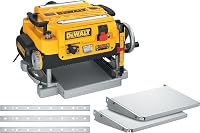
DeWalt DW735X 13-Inch Thickness Planer
The DeWalt DW735X suits frequent project work where selectable feed settings and repeat thicknesses matter. Its gearbox offers 96 or 179 cuts per inch, and a turret depth stop helps you return to common dimensions.
The package includes an extra knife set and a material removal gauge. Its automatic carriage lock reduces movement associated with snipe, although long boards still need proper support.
Choose it for repeated batches of furniture parts or projects where you want a separate final-pass setting. These controls are useful when you're moving between rough dimensioning and surface preparation.
Skip it if frequent lifting is essential. At 102 lb, it needs a practical mounting and storage plan before it arrives.
Read the DeWalt DW735X review if this is your leading choice and you want to examine its controls more closely.
WEN PL1326 13-Inch Spiral Planer
The WEN PL1326 suits buyers who prefer servicing small cutters instead of long knives. Its spiral head has 26 staggered, rotatable HSS blades, and its single-speed feed moves stock at 26 ft per minute.
It accepts boards up to 6 in thick and includes a depth stop. Height-adjustable infeed and outfeed tables support the workpiece, while predrilled base holes allow bench or stand mounting.
Choose it if the cutter arrangement matches how you want to handle worn or damaged edges. Read the rotation and replacement procedure first, since servicing multiple small blades requires careful attention to each fastener.
Skip it if selectable feed settings are a priority. Also avoid choosing it simply because you expect every spiral head to have carbide cutters; this model uses high-speed steel.
Craftsman CMEW320 12.25-Inch Planer
The Craftsman CMEW320 suits buyers whose boards fit its narrower cutting capacity and who prefer a conventional knife-change routine. Its solid steel cutterhead uses 2 quick-change, double-edged knives.
The reversible edges give you another cutting edge when the first becomes worn, following the required service procedure. Craftsman backs the machine with a 3-year limited warranty.
Choose it for individual boards and project parts that stay comfortably within its opening. It makes sense when you want to dimension lumber without making selectable feed settings a purchase requirement.
Skip it if your regular boards need the extra width of a larger opening. A small capacity difference becomes a daily frustration when the lumber you buy repeatedly exceeds it.
Do not choose solely by the amount of material a planer can remove at once. Light passes still help protect the surface and reduce strain when working with wide or dense stock.
VEVOR 13-Inch Planer with Folding Stand
The VEVOR suits buyers who need a dedicated support arrangement rather than permanent bench space. It accepts stock from 0.2 to 6.3 in thick and includes metal return rollers for moving boards back between passes.
Choose it when an included stand solves a real layout problem. Check the working height and allow space around the machine with its supports extended.
The machine includes an electromagnetic power-off protection switch and an overcurrent protector. Those features do not replace correct feeding, suitable electrical supply or keeping hands away from the openings.
Skip it if you expect folding supports to eliminate the need for floor space. The board still needs a clear path through the planer, and long stock may need separate support beyond the extension plates.
For reclaimed wood, inspect every face and edge for embedded metal before feeding it. Old paint, dirt and grit also need attention before the board reaches the cutting edges.
How much shop space and chip collection do you need?
Allow room for the entire board on both sides of the planer, plus a collection hose that stays clear of its path. The machine's stored footprint is only part of its working space.
Map the feed path using your longest likely board. Check for shelves, doorways, vehicles and other tools that could block the board as it moves through.
A stand can free bench space, but it needs a firm, level position during use. If the stand has wheels, secure it according to its instructions before starting the planer.
Long boards need support near the bed's working height. Supports set too high can lift a board, while low supports allow its weight to pull down on an end.
Plan chip collection before the first project. Use our small-shop dust collector guide to consider equipment capacity alongside the planer's connection and airflow requirements.
Fan-assisted ejection moves chips out of a machine, but it does not replace suitable collection or control all airborne dust. Follow the manual and use appropriate eye, hearing and respiratory protection.
Keep hoses short and direct where practical, without sharp bends that encourage blockages. Make the container easy to inspect and empty, since planing can produce a large pile of chips quickly.
Our benchtop workshop machine setup guide can help you place the planer among other tools while keeping its feed path usable.
How should you set up a planer for the first project?
Start with secure mounting, correctly aligned supports and a clean reference face. Good setup prevents avoidable feeding problems before you begin adjusting cut depth.
- Read the manual's stock limits, mounting instructions and electrical requirements.
- Secure the planer and check that its base does not rock.
- Check table alignment using the method in the manual.
- Connect chip collection and arrange external board supports.
- Inspect the lumber for metal, loose knots, dirt and unsuitable coatings.
- Identify the flat reference face and mark your target thickness.
- Begin with a light cut on suitable scrap within the machine's size limits.
Measure the board at several points rather than trusting one end. Start from the thickest area so an unexpected high spot does not turn the first pass into a heavy cut.
Feed with the grain where possible. If a board shows tearout, reduce the cut and reconsider its feed direction before removing more wood.
Keep your hands outside the feed openings and stand clear of the board's direct path. Never reach inside to clear a stalled piece or chip buildup; shut down and disconnect power first.
For a full feeding sequence, follow our guide to using a thickness planer.
Which mistakes cause poor planer results?
The most common mistakes are taking too much wood at once, feeding unstable stock and losing control of board support. Changing machines will not solve those workflow problems.
Expecting the planer to remove twist
A board can pass through evenly and still emerge twisted if its lower face was never flat. Prepare that reference face first, or use a properly secured sled that supports the board without rocking.
Using the maximum cut on every pass
A maximum cut is a limit under the conditions described in the manual, not a target. Wide stock and difficult grain often call for shallower cuts, especially near the final dimension.
Letting long ends drop
An unsupported end can change how the board sits as it enters or leaves the cutterhead. Keep support steady without lifting the board or forcing it against the tables.
Our guide to stopping planer snipe explains how support and machine adjustment affect those deeper cuts near board ends.
Chasing the final thickness too quickly
Stop and measure as you approach your target. Leave enough material for the final surface preparation your project needs, rather than planing to size and then sanding it undersize.
What care keeps a thickness planer working well?
Keep the bed, feed system and cutting edges clean, and service them only with power disconnected. A simple inspection routine is easier than diagnosing poor feeding halfway through a batch.
Remove chips from accessible areas and check the exhaust path after use. Empty collection equipment before packed chips restrict flow.
Clean resin from rollers and the bed using the method and materials approved in the manual. Avoid leaving an oily surface that can transfer to wood or affect a later finish.
Watch for repeated raised lines, torn grain or increasing feed trouble. These symptoms can point to damaged edges, dull cutters, buildup or setup problems, so inspect before increasing cutting depth.
Follow the required sequence and fastener settings when rotating cutters or changing knives. Store spare cutting edges safely and keep the correct tools with the machine.
Which thickness planer should you choose?
Choose your thickness planer by eliminating capacity and layout mismatches first, then paying for the controls you will use. Buying extra features makes little sense if the machine cannot handle your regular boards or fit your workflow.
Pick the DeWalt DW735X for frequent batches and selectable feed settings. Pick the WEN PL1326 if individual rotatable cutters suit your maintenance preferences and a fixed feed meets your needs.
Choose the Craftsman CMEW320 when your stock fits its opening and you prefer reversible long knives. Choose the VEVOR when its included stand helps you create a usable station.
Before ordering, write down your widest board, longest board and planned mounting location. Then read how to use a thickness planer so your first project starts with a clear milling plan.
Frequently asked questions
What size thickness planer should I buy?
Buy a thickness planer wide enough for the boards you expect to use regularly. Measure actual lumber and planned glue-ups, then check maximum workpiece thickness separately.
Leave space for the full board to enter and exit, since cutting capacity alone does not tell you whether a machine fits your shop.
Is a spiral cutterhead better than a straight-knife cutterhead?
Choose between them by comparing blade care and replacement costs. Small rotatable blades let you service individual cutting edges, while straight-knife heads use long knives changed according to the machine's instructions.
Cutterhead style alone does not guarantee a clean surface; grain direction, sharp edges and shallow passes still matter.
Do I need a dust collector for a thickness planer?
Plan for collection equipment that meets your thickness planer's manual requirements. Planers remove enough wood to fill a small container quickly, and a dust port only provides the connection.
Check hose size, required airflow and chip capacity, then keep the hose clear without allowing it to obstruct board travel.
Can a thickness planer flatten a twisted board?
A thickness planer needs a flat reference face to make the opposite face flat and parallel. Its rollers can press a twisted board down during a cut, allowing the twist to return afterward.
Flatten one face with a jointer or use a properly secured planer sled before thicknessing the opposite face.
How much material should I remove in one pass?
Use the machine's manual to set the maximum cut, then take shallower passes on wide boards, dense wood or difficult grain. Maximum workpiece thickness is not cutting depth per pass.
Start with a light cut and reduce it further if feeding becomes uneven or the surface begins to tear.