Planer vs Jointer: Which Do You Need? (October 2026)
A jointer flattens one face and squares an edge; a planer makes the opposite face parallel at a set thickness. Choose by the job your lumber needs first.
On this page (9 sections)
- Planer vs jointer: what does each tool do?
- Which tool should you choose for your lumber?
- Can you use a planer without a jointer?
- Can a jointer replace a thickness planer?
- What is the usual jointer and planer workflow?
- How much board width can these tools handle?
- Which tool fits a small workshop?
- What safety and dust details should you check?
- Which tool should you get first?
A jointer flattens one face and squares an edge; a planer makes the opposite face parallel at a set thickness. For rough lumber, the usual sequence is to joint a face, joint an edge, plane the other face, then rip the remaining edge parallel.
These tools solve related but different problems. A board can be smooth and still be twisted, tapered, or uneven in thickness, so start by identifying what needs correcting.
Planer vs jointer: what does each tool do?
A jointer creates a flat reference face and a straight edge; a thickness planer uses that reference face to size the board. Neither machine does both jobs alone without another flattening method or suitable jig.
A jointer has an infeed table, cutterhead and outfeed table. You guide the board across the cutterhead to remove high spots and establish a flat face or straight edge.
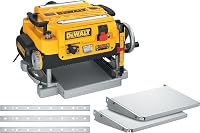
A thickness planer feeds a board through a cutterhead above a bed. With the flat face down, it cuts the top face parallel to the bottom, reducing the board to a more even thickness.
The distinction matters with rough lumber. If you put a twisted board straight through a planer, the rollers can press it flat during the cut; it may spring back to its original twist afterward.
What does a jointer fix?
A jointer helps correct a cupped or bowed face, and its fence helps guide edge jointing. Flatten one face first, then hold that face against a fence set square to the table to square an edge.
A jointer doesn't guarantee a specific final thickness across the board. Repeated passes can make the face flatter, but they won't make the opposite face parallel the way a planer does.
For a deeper explanation of the jointing steps and uses, see what a jointer is used for.
What does a thickness planer fix?
A thickness planer makes a board thinner and brings its faces parallel when one face is already flat. It can also help bring several boards to a consistent thickness for a panel or project.
It doesn't correct a crooked edge. Use a jointer or another suitable edge-straightening method before ripping if the board lacks a straight reference edge.
For setup, feed direction, and pass planning, read how to use a thickness planer.
Which tool should you choose for your lumber?
Choose a jointer for uneven reference surfaces; choose a planer when a flat face exists but thickness varies. The condition of your stock matters more than the project name.
A home-shop woodworker who buys surfaced lumber may already have boards with usable reference faces. In that case, a planer may be the more useful first machine for matching thickness.
Rough-sawn lumber often arrives cupped, bowed, or twisted. A jointer can prepare one face and one edge before the planer brings the opposite face to size.
When is a jointer the better first buy?
A jointer is the better first buy if you regularly process rough boards that arrive with uneven faces or edges. It gives you the reference surface a planer needs.
It may be less useful if your lumber is already flat, straight and close to the thickness you need. In that situation, you may get more immediate value from a planer.
The WEN JT630H 6-Inch Spiral Jointer has a 6 in cutting width and a 30 x 6 in table. Its spiral cutterhead uses 12 staggered HSS blades, and its fence bevels up to 45 degrees.
That width limits the face size you can joint in one pass. For wider boards, consider whether a different workflow, such as a flattening sled and router, fits your shop and skill level.
When is a planer the better first buy?
A planer is the better first buy if your boards already have a flat face and need a consistent thickness. It can also help match thickness across multiple boards for a glue-up.
The Craftsman CMEW320 12.25-Inch Planer has a 12.25 in cutting width and a two-knife cutterhead with reversible, double-edged knives. It has a vacuum port for dust collection.
A planer can remove material from an uneven board, but it follows the surface supported on its bed. If the underside rocks or twists, make a stable, flat reference face before thicknessing.
Read ways to stop planer snipe to understand how support and setup affect the ends of a board. Preventing snipe doesn't replace flattening twisted stock.
Can you use a planer without a jointer?
Yes, if your boards already have a flat face or you create one with another method. A planer doesn't require a jointer specifically, but it does need a stable reference surface.
For a small number of boards, hand planes can flatten a face and straighten an edge. A properly secured planer sled can support an uneven board without rocking or flexing while the planer cuts its upper face flat.
Once that face is flat, remove the sled and plane the opposite face with the flat face down. Follow the machine manual and a suitable sled design for securing the board and its supports.
A sled takes setup time and must hold the work securely within the machine's capacity. Don't feed stock or a sled assembly that can shift, tip or exceed the manual's limits.
A planer-only setup can work well for surfaced lumber or smaller projects. If you routinely process rough stock, the extra flattening step may make a jointer worthwhile.
Can a jointer replace a thickness planer?
A jointer can flatten a face, but it can't reliably make two faces parallel at a set thickness. A jointer-only shop can prepare surfaces, but matching thickness across several boards needs another method.
Jointing the second face doesn't control its distance from the first face. A board can end up flat on both sides yet still be tapered or vary in thickness across its width.
Hand planes can bring the second face to thickness with careful marking and measurement. A thickness planer offers a more direct machine workflow once you have a flat reference face.
A planer sled still requires a thickness planer, so it replaces the initial face-jointing step rather than the thicknessing machine. Choose the workflow based on which tool you already have and how much rough stock you process.
What is the usual jointer and planer workflow?
Joint one face and one edge first, then plane the opposite face and rip the remaining edge parallel. This sequence establishes one flat face and one square edge as references.
- Inspect the board for loose knots, metal, cracks, or other hazards, and follow each machine's manual.
- Joint one face until it is flat, checking it with a straightedge.
- Set the jointer fence square to the table, place the flat face against it, and joint one edge straight and square.
- Put the flat face down in the planer and take gradual passes until the board reaches the desired thickness.
- With the flat face on the saw table and the straight edge against the fence, rip the opposite edge parallel using the saw's guards and handling aids as directed.
Keep each pass within the tool's stated limits. Check the board often with a straightedge and measuring tool rather than removing more material than needed.
For a comparison of benchtop options, see our guides to the best benchtop jointers and the best thickness planers.
How much board width can these tools handle?
The WEN jointer handles 6 in of cutting width, while the Craftsman planer handles 12.25 in. Match the tool to your most common board size and follow its limits for each cut.
The WEN JT630H 6-Inch Spiral Jointer has a 6 in cutting width. The Craftsman CMEW320 12.25-Inch Planer gives you more room for wide stock during thicknessing.
A planer can accept a board wider than a jointer can flatten in one pass. That doesn't make the board ready to plane: it still needs a stable, flat reference face.
Measure typical project parts and the rough boards you can source locally. If many pieces exceed a jointer's width, plan another suitable flattening method before choosing a narrow benchtop jointer.
Which tool fits a small workshop?
Compare the footprint and board feed path before choosing either machine for a small workshop. Cutting width alone doesn't tell you how much working space a tool needs.
The WEN JT630H 6-Inch Spiral Jointer measures 30 x 12.5 x 17.5 in. The Craftsman CMEW320 12.25-Inch Planer measures 23.5 x 17.5 x 15.4 in.
Those machine dimensions don't include the clear space needed to feed and support boards. A long board needs support on both sides, and you need room to stand without bumping into other equipment.
Our small woodworking shop setup guide covers how to prioritize machines and work surfaces in a compact space. Think through where stock will enter, where it will exit, and how you'll collect chips before setting either tool in place.
What safety and dust details should you check?
Follow each machine's manual for guards, handling aids and dust collection. Both tools have cutting hazards and produce chips and dust, even when collection equipment is connected.
The WEN jointer includes two push blocks and a 2.5 in dust port. Its spring-loaded blade guard limits the exposed cutterhead area during jointing; keep the guard in working order and use the push blocks as directed.
The Craftsman planer has a vacuum port for dust collection. Connect a suitable collection setup and clear blockages only after the machine is off, unplugged and fully stopped.
A dust port doesn't guarantee that all airborne dust is captured. Follow the manual's directions for dust control and personal protective equipment.
Read the manuals before use for stock limits, cutter changes and adjustments. Keep hands away from cutting areas, and don't feed stock shorter, thinner or narrower than the machine allows.
Which tool should you get first?
In a planer vs jointer decision, pick a jointer for rough reference surfaces and a planer for uniform thickness once a flat face exists. If you regularly process rough boards from start to finish, both machines cover complementary steps.
Choose the WEN JT630H 6-Inch Spiral Jointer if face flattening and edge jointing are the gaps in your shop, and its 6 in width suits your boards. Choose the Craftsman CMEW320 12.25-Inch Planer if you already have flat reference faces and need its 12.25 in cutting width.
For a jointer-first choice, compare benchtop jointer options. If thicknessing is your main need, use our thickness planer guide to plan the next step.
Frequently asked questions
Can a planer flatten a board?
A thickness planer makes one face parallel to the opposite face, but it won't reliably flatten a cupped or twisted board by itself. Start with a flat reference face made with a jointer, hand planes or a properly secured planer sled, then plane the other face to thickness.
Do I need both a jointer and a planer?
Both tools suit the straightforward machine workflow for flattening rough lumber and bringing it to an even thickness. A jointer prepares a flat face and square edge; a planer makes the other face parallel.
Hand tools or a suitable planer sled can replace the jointer in some shops.
Can a jointer make a board the same thickness?
A jointer can flatten a face and straighten an edge, but it doesn't make the opposite face parallel at a consistent thickness. For that, feed the board through a thickness planer with its flat face down, following the machine manual and its stock limits.
What should I buy first, a planer or jointer?
Buy the tool that fixes your most common stock problem. If boards are cupped, bowed or have a crooked edge, a jointer addresses the reference surfaces.
If you already have a flat face and need even thickness, a planer is the more direct fit.