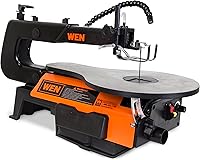
WEN 3921 Scroll Saw Review: Worth It? (October 2026)
The WEN 3921 scroll saw suits detailed wood projects and occasional long rips thanks to its two-direction blade setup. Choose the 3922 or 3923 instead if frequent access to the lower blade holder matters more.
On this page (10 sections)
- What does the WEN 3921 scroll saw offer?
- Is the WEN 3921 a good fit for your projects?
- Which WEN 3921 specifications matter before you buy?
- How should you set up the 3921 before its first project?
- How do blade choice and feed speed affect the cut?
- What care does the WEN 3921 need?
- Which alternative should you choose instead?
- Which mistakes make scroll-saw work harder?
- How should you choose between the WEN 3921 and 3923?
- Is the WEN 3921 scroll saw worth choosing?
The WEN 3921 scroll saw is a good fit for detailed woodwork with occasional long rips, thanks to a blade holder that allows cutting in two directions. Choose it for that flexibility; choose an alternative with an opening side panel if your patterns require frequent blade threading.
For CivilCupboard, the deciding factor is your project layout. A long sign blank and a small ornament with dozens of enclosed openings place different demands on a saw.
What does the WEN 3921 scroll saw offer?
The 3921 offers detailed cutting with extra clearance for long rips when you turn the blade sideways. Its main advantage is the choice of cutting direction.
WEN 3921 16-Inch Scroll Saw: Best for mixed-size projects
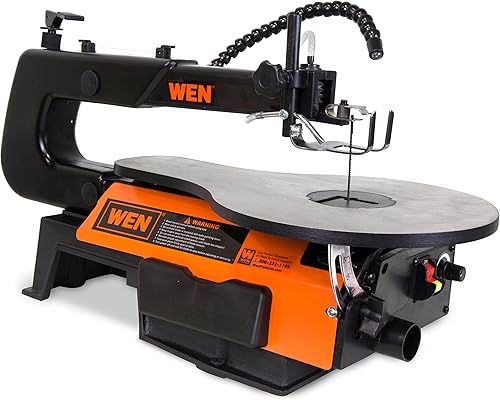
- 16 in throat depth
- Variable speed up to 1600 strokes per minute
- Blade turns 90 degrees
- Table bevels up to 45 degrees left
Choose the 3921 for detailed patterns and occasional long rips using its sideways blade position. Its flexible light and air pump help keep the cut line visible.
Pros
- Two blade directions
- Accepts pinned and pinless blades
- Flexible work light
- Onboard blade and holder storage
Cons
- Blade repositioning adds a setup step
- Table bevels left only
- Long workpieces need separate support
This setup suits someone moving between small decorative pieces and longer blanks. A narrow scroll-saw blade can follow curves, while the alternate mounting position gives you another way to feed a workpiece that would otherwise meet the rear arm.
The flexible work light and adjustable air pump help you follow a pencil line or paper pattern. Onboard storage also gives loose blades and holders a home between projects.
Buy the 3921 if you can name a project that benefits from the sideways position. Skip it in favor of an opening-panel model if your usual work involves repeatedly removing and reconnecting the blade through small holes.
How does the WEN 3921 scroll saw's sideways blade position help?
The sideways position lets you feed a long piece across the table without its length running into the rear arm. WEN describes this as allowing rips beyond the standard throat depth.
That extra clearance doesn't provide extra table support. A long board still needs support at the table's height so its weight cannot pull the cut off course.
The change requires repositioning the blade, so plan your cuts before switching. It also doesn't turn a scroll saw into the best tool for batches of long, straight boards.
Is the WEN 3921 a good fit for your projects?
Choose the 3921 for small curves, decorative outlines and interior cutouts, with the option of longer cuts when needed. Skip this type of saw if your main work is breaking down large boards or making thick structural parts.
For an enclosed cutout, you drill a starter hole, thread the blade through it and reconnect the blade before cutting. A pattern with many openings repeats that process, making holder access a practical buying factor.
Look beyond the blank's outside dimensions. Check whether you can rotate it through the whole pattern without hitting the saw's arm or losing support.
The scroll saw beginner's guide explains basic cutting practices. For project ideas, what a scroll saw is used for shows where this machine earns its bench space.
Which WEN 3921 specifications matter before you buy?
Check throat clearance, wood thickness and blade fit before comparing convenience features. These determine whether the saw can handle your intended pattern.
| Detail | WEN 3921 |
|---|---|
| Throat depth | 16 in in standard position |
| Maximum wood thickness | 2 in |
| Speed | Variable, up to 1600 strokes per minute |
| Table bevel | Up to 45 degrees left |
| Blade positions | Standard and 90 degrees |
| Blade compatibility | Pinned and pinless |
| Blade changes | Thumb screw adapter |
| Included equipment | Foot lock clamp, air pump, flex light, dust port and onboard storage |
| Included blades | 3 |
| Base | Cast iron |
Throat depth measures clearance behind the blade, not blade length. A blank may fit on the table yet run into the rear arm as you turn it.
Maximum thickness also needs context. Thick stock makes tight turns harder and places more demand on the blade, so start with thinner scraps while learning feed control.
For bevel work, plan the direction of the tilt before laying out your pieces. Return the table to square after angled cuts rather than assuming its previous setting remains correct.
If your work centers on thicker stock and open curves, read band saw vs scroll saw before committing bench space.
How should you set up the 3921 before its first project?
Start with a stable bench, a correctly fitted blade and a square table. These steps matter more to cut control than immediately choosing the fastest speed.
- Choose the position. Leave room for the workpiece to turn, space for long-stock supports and access to the controls.
- Mount the saw. Follow WEN's mounting instructions; a heavy base still needs a sound surface beneath it.
- Fit the blade with power disconnected. Follow the manual for tooth direction, clamping and tension.
- Check the table. Use a small square beside the blade, avoiding the teeth, to check the starting position.
- Set the hold-down foot. Adjust it as directed so it helps control lifting while allowing the wood to move.
- Arrange visibility and dust collection. Aim the light and air nozzle at the cut without blocking your view.
Use an offcut of the same material before cutting the finished blank. Make a straight cut, a broad curve and a turn similar to the pattern's tightest corner.
Check both faces of that offcut. If the cut slopes through the thickness, recheck the table, blade condition, tension and feed pressure before continuing.
How do blade choice and feed speed affect the cut?
Choose a blade suited to the stock and the smallest turn, then feed gently enough that it stays straight. More pressure won't make a fine blade behave like a heavier one.
Pinned blades have crosspins at their ends, which affect the size of hole they can pass through. Pinless blades are useful for fine interior work where a smaller entry hole preserves more of the pattern.
Wider blades generally handle broader curves better, while narrower blades can turn more tightly. Tooth spacing must also suit the material, with room for sawdust to clear rather than pack into the cut.
Start at a moderate speed on scrap and adjust gradually. Burning, heavy fuzz or repeated blade breakage calls for checking blade choice, sharpness and feed pressure rather than simply turning the speed higher.
Guide the wood without forcing it sideways. Slow down before a tight turn, and make relief cuts in waste areas when the pattern allows.
What care does the WEN 3921 need?
Keep the blade holders, table and dust path clean, and check blade condition before each project. Disconnect power before cleaning, changing blades or making adjustments near the cutting area.
Brush or vacuum loose dust from accessible areas. Keep blade-clamping surfaces clear so dust doesn't interfere with seating the blade.
Replace a blade that is bent, damaged or no longer cuts cleanly with gentle feed. Follow the manual for tension release, lubrication and storage rather than adding oil to clamps or other parts at random.
The air pump clears the cut line, while the dust port connects to collection equipment. Neither makes visible cleanliness a measure of the air you breathe.
Use eye protection and dust protection suited to the wood and workspace. Our small-shop dust collector guide can help you plan collection alongside your other bench tools.
Which alternative should you choose instead?
Choose an alternative when blade access, lighting or accessory storage solves a more frequent problem than the 3921's sideways blade position. Match that choice to your usual pattern rather than an occasional project.
WEN 3922 16-Inch Scroll Saw: Best for frequent interior cuts

- 16 in throat depth
- 550–1600 strokes per minute
- Side panel opens for blade changes
- Table bevels up to 45 degrees
The opening side panel makes the 3922 a sensible choice for patterns that require repeated access to the lower blade holder. It accepts pinned, pinless and spiral blades.
Pros
- Opening panel gives lower-holder access
- Tool-free blade adapter
- Accepts pinned, pinless and spiral blades
Cons
- Standard throat can restrict larger patterns
- Maximum wood thickness is 2 in
WEN 3922: choose it for repeated blade threading
The 3922's opening side panel gives access to the lower blade holder. That matters for fretwork, where each enclosed opening can require another disconnect, thread and reconnect cycle.
It accepts pinned, pinless and spiral blades, with variable speed from 550 to 1600 strokes per minute. Its table bevels for angled work, and an air pump helps clear the pattern line.
Choose it if you already have suitable bench lighting and want the opening panel to be the main convenience. Skip it if the 3921's alternate cutting direction solves a specific clearance problem in your planned work.
For a closer look at that trade-off, see the WEN 3921 and 3922 comparison.
WEN 3923 16-Inch Scroll Saw: Best for dim workbenches

- 16 in throat depth
- 550–1600 strokes per minute
- Easy-access blade panel
- Flexible work light
The 3923 pairs an opening blade-access panel with a flexible work light. Choose it when frequent blade threading and shadows around the cut line are your main concerns.
Pros
- Opening panel gives lower-holder access
- Flexible work light
- Accepts pinned, pinless and spiral blades
- Air pump and dust port
Cons
- Standard throat can restrict larger patterns
- Maximum wood thickness is 2 in
WEN 3923: choose it for blade access with adjustable light
The 3923 combines an opening side panel with a flexible work light. That combination suits detailed patterns when room lighting casts shadows near the blade.
Its holder accepts pinned, pinless and spiral blades. The included air pump and dust port address cut-line clearing and collection, while the table bevels for angled cuts.
Choose this model if you expect many interior openings and want to direct light onto the work. Move the light as needed so the blade or hold-down foot doesn't cast a shadow across your next turn.
Skip it if longer ripping clearance is your main reason for considering the 3921. For that buyer, the sideways blade option remains the stronger reason to choose.
SKIL SS9503 16-Inch Scroll Saw: Best for shared hobby benches

- 16 x 10 in work table
- Electronic variable speed
- Integrated dust removal
- Keyless blade change
The SKIL combines an LED work light, dust removal, keyless blade changes and on-tool blade storage. Those features suit a hobby bench where keeping small accessories together matters.
Pros
- Integrated LED work light
- Integrated dust removal
- Keyless blade change
- On-tool blade storage
Cons
- Requires nearby corded power
- Table tilt is limited to 45 degrees
SKIL SS9503: choose it for a shared hobby workspace
The SKIL brings together an integrated LED work light, dust removal, keyless blade changes and on-tool blade storage. Keeping spare blades at the machine can help when a bench serves several crafts.
Electronic variable speed gives you control over the cutting pace. Its 16 x 10 in table tilts from 0 to 45 degrees, and SKIL backs the saw with a 3-year limited warranty.
Choose it if you want these conveniences grouped at the saw and don't need the WEN's two-direction setup. Skip it if your purchase depends on a particular blade type or stock thickness until you've confirmed those requirements for the exact model.
Which mistakes make scroll-saw work harder?
The most common mistakes are forcing the feed, choosing a blade only by thickness and ignoring workpiece support. Correct these before blaming the saw's speed setting.
- Pushing through a tight corner: ease the feed and let the blade cut; sideways pressure can bow or break it.
- Starting with the final blank: practice the hardest turn on matching scrap first.
- Choosing pinned blades for tiny openings: account for the end pins when sizing starter holes.
- Letting a long blank hang: support it level with the table so its weight doesn't steer the cut.
- Leaving the table tilted: check square before returning to ordinary pattern work.
- Treating the hold-down as a vise: adjust it for controlled movement as directed in the manual.
- Chasing a slipping blade with more tension: disconnect power and check its seating and clamps first.
Keep your fingers out of the projected blade path, including where they could move if the wood slips. Stop the saw before clearing trapped scraps near the blade.
How should you choose between the WEN 3921 and 3923?
Pick the 3921 for longer-cut clearance and the 3923 for repeated lower-holder access with adjustable lighting. Shared cutting features matter less than the task you'll repeat most.
Write down your next 3 projects. If they contain many enclosed shapes, count the blade-threading steps; if they use long blanks, check the space needed to feed and support those blanks.
If the 3922 remains on your shortlist, the WEN 3921 vs 3922 comparison explains their different blade setups. Our best scroll saws guide covers a broader set of options.
Is the WEN 3921 scroll saw worth choosing?
Buy the WEN 3921 scroll saw when its alternate blade direction solves a real project constraint. Plan the workpiece support at the same time, since longer clearance is useful only when you can guide the blank safely.
Choose the 3922 for repeated blade access, the 3923 for that access plus a flexible light, or the SKIL for its grouped bench conveniences. If your projects call for a different kind of machine, use the scroll and band saws guide to narrow the tool choice first.
Frequently asked questions
What makes the WEN 3921 different from the 3922?
The WEN 3921 offers a blade position turned 90 degrees for long rips, while the 3922 has an opening side panel for lower-holder access. Choose by your work: longer cuts favor the 3921's layout, while repeated blade threading makes access to the holder more useful.
How thick can the WEN 3921 cut?
The WEN 3921 cuts wood up to 2 in thick, but that capacity is a limit rather than a target for every pattern. Tight curves in thick stock need careful blade choice and a slow feed; turning the blade sideways changes workpiece clearance, not the maximum cutting thickness.
Does the WEN 3921 accept pinless blades?
Yes, the WEN 3921 accepts pinned and pinless blades through its blade-holder setup; pinless blades are useful for interior patterns because they can pass through smaller starter holes than pinned blades. Disconnect power before fitting either type, and follow WEN's instructions for clamping, orientation and tension.
Should you choose the WEN 3921 or 3923?
Choose the 3921 for occasional long rips using the sideways blade position, or the 3923 for an opening side panel that helps you reach the lower holder. Both include flexible work lights; for patterns with many enclosed openings, blade access is likely to matter more than longer ripping clearance.