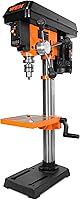
How to Choose a Drill Press for a Home Shop
Choose a drill press by the hole locations, drilling depths and bits your projects require. Match those needs to swing, spindle travel and speed range, then check table clearance and bench space.
On this page (11 sections)
- What size drill press do I need?
- How much spindle travel and vertical clearance do you need?
- Which drill press speed control should I choose?
- How do chuck size and motor power affect your choice?
- How much table space and shop room do you need?
- Which features matter for accurate, repeatable holes?
- Which drill press fits different home shop needs?
- How should you set up a drill press before the first hole?
- Which drilling mistakes cause poor holes or unsafe setups?
- What care does a home shop drill press need?
- How do you make the final drill press decision?
Choose a drill press by matching its reach, drilling depth and speed range to the holes you make most often. Buy more capacity when it solves a known problem, such as reaching the center of a wider part or drilling a deeper hole in one stroke.
Start with 3 real projects rather than a motor size or feature list. Record the hole locations, material thicknesses and bits they need, then measure the bench where the machine will live.
What size drill press do I need?
Choose the swing that reaches your farthest hole location, with room for the workpiece and clamps. Swing is twice the distance from the column to the spindle center.
| Swing | Approximate spindle-to-column reach | Useful starting point |
|---|---|---|
| 8 in | 4 in | Small parts and holes near an edge |
| 10 in | 5 in | Parts needing a little more reach |
| 12 in | 6 in | Wider parts with holes farther inward |
The size describes reach, not maximum hole diameter. An 8-inch drill press does not take an 8-inch drill bit.
Measure from the intended hole center to the edge that will face the column. For an awkward shape, draw its outline on cardboard and mark the hole centers to see how you could turn it under the spindle.
A wide board can sometimes fit when the hole sits near an edge. A smaller piece can still be difficult if a clamp, raised feature or curved edge blocks its position against the column.
How much spindle travel and vertical clearance do you need?
Choose enough spindle travel for the drilling depth, then check that the entire setup fits beneath the chuck. Travel and clearance solve different problems.
Spindle travel is how far the spindle moves down in one stroke. A deep hole may require more travel even when the workpiece fits easily on the table.
Vertical clearance must accommodate the bit, workpiece, backing board and any vise or fixture. Long bits and tall workholding can use up that space before drilling begins.
For example, a shallow blind hole in a thick block needs little travel but plenty of clearance. A deep through-hole needs both clearance and enough downward movement.
Do not plan routine work around raising an unsecured part toward a spinning bit. If the setup needs repositioning to finish a hole, stop the machine and follow a method allowed by its manual.
Which drill press speed control should I choose?
Choose fixed speeds for repeated jobs and variable speed for frequent changes in materials or bit sizes. In either case, the available RPM range must suit the cutter.
Larger cutters generally need slower speeds than small bits in the same material. Metal type, bit material and cutter design also affect the right setting, so use the bit maker's guidance.
A high top speed is not a reason to choose one press over another if most of your work calls for slow rotation. Check the lower end first when planning larger holes or metalwork.
On a belt-adjusted press, unplug the machine before opening the belt cover or changing belt positions. Mechanical variable-speed controls may have a different adjustment procedure, so follow the model's manual.
Our drill press speed chart for wood gives a starting point for comparing common woodworking tasks. A digital readout helps you see the selected speed, but feed pressure and a sharp, suitable bit still matter.
How do chuck size and motor power affect your choice?
Match the chuck to the bit's shank diameter, and judge the motor alongside speed range and the intended job. Chuck capacity alone does not guarantee a safe cutting diameter.
A reduced-shank bit can have a cutting head wider than its shank. Its ability to fit in the chuck does not mean the press can drive it safely through every material.
The WEN 4206T, WEN 10-inch model and SKIL accept shanks up to 1/2 inch. The WEN 12-inch model has a 5/8-inch chuck, which matters if your existing bits need that larger opening.
Motor amperage is useful context, but it is not a direct measure of drilling accuracy or usable torque at every speed. Choose around your actual material, hole size and workload rather than the largest amp number.
How much table space and shop room do you need?
Allow room for the whole drilling setup, including long stock, clamps and handle movement. A base that fits on the bench is only the first check.
The WEN tables grow from 6.5 by 6.5 inches on the 4206T to 8 by 7.5 inches on the 10-inch model and 9.5 by 9.5 inches on the 12-inch model. Larger tables offer more support, but long boards still need separate support.
Place those supports so the stock stays level without tipping or rocking. Leave room to reposition the work without reaching across the spindle.
Check overhead shelves and access to the belt cover, as well as table movement below the chuck. The WEN 4206T is about 23 inches tall, compared with about 34 inches for the 10-inch model and 37 inches for the 12-inch model.
Bench height affects comfort too. You should be able to see the hole mark and operate the feed handle without stretching or leaning close to the rotating parts.
For a shared bench, plan where parts and clamps will go during drilling. Our benchtop workshop machines guide can help you arrange the surrounding tools.
Which features matter for accurate, repeatable holes?
Prioritize secure workholding, a square table and a usable depth stop before alignment aids. These control the workpiece and drilling depth throughout the cut.
For repeated hole patterns, a fence and stop block can locate each part without measuring every time. Arrange them so the bit clears the fixtures and the work cannot rotate into an open gap.
An adjustable depth stop helps repeat blind holes. Set it using scrap of the same thickness, especially when the bit's pointed tip extends below the flat part of the hole.
Lasers help position a mark, while a work light makes the bit and surface easier to see. Confirm the actual bit position before starting, and keep your eyes out of the laser beam.
A drill press vise must be secured to the table rather than simply placed on it. Our bench vise guide covers a different tool category, so do not assume a vise meant for a bench will mount safely on a drill press.
Which drill press fits different home shop needs?
Choose the model that fixes your main capacity or workflow limit. The following options suit different combinations of reach, depth, speed adjustment and bench space.
WEN 4206T 8-Inch Drill Press: small parts on a compact bench
Choose the WEN 4206T for small parts when a shorter machine makes the bench easier to use. Its 2.3-amp induction motor and compact layout suit buyers whose routine projects fit close to the column.
It has 2 inches of spindle travel and speed settings of 750, 1,100, 1,500, 2,100 and 3,200 RPM. Speed changes require moving the belt, so it makes sense for batches of similar holes.
The table tilts up to 45 degrees in either direction. Its slots accept suitable clamps or a vise, and the locking depth stop helps with repeated depths.
Skip this model if wide panels, deeper holes or cutters requiring slower speeds are regular jobs. Read our WEN 4206T drill press review if its size matches your projects.
WEN 12-Inch Benchtop Drill Press: wider parts and deeper holes
Choose the WEN 12-inch model when extra reach and travel solve a recurring problem. Its 3-1/8-inch spindle travel gives it a clear advantage over the smaller WEN options for deeper drilling in one stroke.
The 6.2-amp induction motor has mechanical variable-speed adjustment from 580 to 3,100 RPM. A laser, overhead light and table roller extension help with positioning, visibility and supporting stock.
Its table tilts 45 degrees left and right. The adjustable depth stop also suits batches of parts that need the same hole depth.
Skip it if your projects fit comfortably on a smaller press and overhead room is tight. The added capacity should earn its place on the bench through work you expect to do.
WEN 10-Inch Benchtop Drill Press: frequent changes between jobs
Choose the WEN 10-inch model if speed adjustment is your main upgrade from a basic press. It suits a shop that moves between different bits and materials but does not need the larger model's reach.
Its 6.2-amp induction motor, digital speed readout and laser give it a useful set of controls for mixed projects. The adjustable depth stop supports repeated drilling without relying on the laser for depth.
Spindle travel is 2 inches, so the larger frame does not give you a deeper stroke than the 4206T. That is the key limit to check before choosing it for thick stock.
Skip this option if deeper holes are the reason you want a larger press. Choose it when moderate reach and easier speed selection address your actual needs.
SKIL DP9505 10-Inch Drill Press: repeated jobs with built-in lighting
Choose the SKIL DP9505 if you prefer set speed choices with a light and laser. It suits repeated work where one speed setting can cover a batch of holes.
Its 6.2-amp induction motor runs through 5 speeds from 610 to 2,800 RPM. The adjustable depth stop and table height help establish a repeatable setup.
The work surface tilts up to 45 degrees left and right. A bump-off switch provides another way to stop the machine, but arrange the work so you can reach the controls throughout the job.
Skip it if you want to select speeds between fixed steps. Before choosing it for deeper work, confirm spindle travel and assembled clearance against your bit, workpiece and fixture.
How should you set up a drill press before the first hole?
Mount the press securely, check table alignment and rehearse the workholding setup with the power disconnected. Assembly and chuck installation should follow the machine's manual.
Use a bench or stand that can carry the machine and work without rocking. Secure the base through its mounting holes as directed, keeping the controls accessible.
Check that the table is square to the spindle before straight drilling. Return it to square after angled work rather than relying only on the tilt scale.
Set table height with the bit, backing board and workholding in position. Keep enough clearance to load the part without extending the spindle farther than the job requires.
Clamp the work, turn the spindle by hand if the manual permits, and check that the bit clears every clamp and fixture. Remove the chuck key immediately after tightening, then use our drill press operating guide for the drilling steps.
Which drilling mistakes cause poor holes or unsafe setups?
The biggest mistakes are unsecured stock, unsuitable speed and excessive feed pressure. A drill press controls the bit's path, but it cannot correct a moving part or dull cutter.
Never rely on your hand to stop a small part from spinning. Clamp it securely, and support long stock so its weight cannot pull the work off the table.
Use a backing board for through-holes in wood to reduce breakout and protect the table. Ease the feed as the bit exits rather than forcing the last part of the cut.
Clear chips during deeper holes by withdrawing the bit as appropriate for the cutter and material. Stop the machine before clearing packed debris with a brush.
Wear eye protection, tie back long hair, and keep loose clothing, jewelry and gloves away from rotating parts. Wait for the spindle to stop before measuring, adjusting clamps or reaching near the bit.
Do not use an ordinary drill press as a milling machine. Sideways cutting loads require equipment designed for that work, even if the cutter fits the chuck.
What care does a home shop drill press need?
Keep the table, column and chuck clean, and follow the manual's maintenance schedule. A clean setup makes it easier to seat parts flat and spot loose hardware.
Disconnect power before cleaning or making adjustments. Remove chips with a brush or vacuum, and clear the table slots so clamps can seat properly.
Protect bare metal from rust with a treatment suitable for your materials and finish work. Avoid leaving oily residue where it can transfer to unfinished wood.
Inspect belts, cords and mounting hardware regularly. Lubricate only the points named in the manual, and investigate new vibration, slipping or unusual noise before continuing.
How do you make the final drill press decision?
Choose by the first requirement a smaller machine cannot meet: reach, travel, speed or working clearance. That gives you a reason to move up without buying unused capacity.
- Pick the WEN 4206T for small parts and a shorter bench setup.
- Pick the WEN 12-inch model when wider parts or deeper holes justify more space.
- Pick the WEN 10-inch model for variable speed when its stroke covers your drilling depths.
- Pick the SKIL DP9505 when fixed speeds suit your work and built-in lighting is useful.
Before ordering a drill press, write down your required reach, drilling depth and bit speeds beside your bench measurements. Use our best benchtop drill presses guide to compare models against that short list.
Frequently asked questions
What size drill press do I need for a home shop?
Choose a drill press by the hole locations and drilling depths your projects require; measure from each hole center to the edge that will face the column, then check spindle travel and clearance with your bit and workholding in place. Bench space alone cannot tell you whether a machine fits your work.
What does drill press swing mean?
Swing is twice the distance from the column to the spindle center; a 10-inch swing gives about 5 inches of reach, allowing you to center a round workpiece of that diameter under the bit. For other shapes, compare the hole location with the edge that must face the column.
Is an 8-inch drill press big enough?
An 8-inch drill press can suit small brackets, craft parts and holes close to an edge; check your actual hole locations before choosing one, because a wide panel may hit the column. Also allow room for the drill bit, backing board and clamps when checking vertical clearance.
Do I need variable speed on a drill press?
Choose variable speed if you often switch between bit sizes or materials and want finer RPM adjustment; a fixed-speed press can suit repeated work when its speed steps match the bit maker's guidance. Compare the lowest available speed as well as the adjustment method before deciding.
Can I use a drill press for angled holes?
Yes, a tilting table can position stock for angled holes when the workpiece is properly supported and clamped. Check the angle with a suitable measuring tool, allow for the bit's path through the stock and backing, and return the table square to the spindle before drilling straight holes.