Drill Press Speed Chart for Wood
For wood, use higher speeds for small bits and lower speeds for larger cutters, within the bit maker's recommended range. Match the bit type, diameter, and wood to that guidance before choosing a drill press setting.
On this page (8 sections)
- How do you read a drill press speed chart for wood?
- Does the bit type change the recommended RPM?
- What affects the best drill press speed for wood?
- How do you change speed on a drill press safely?
- What signs tell you to slow down?
- How do you choose a drill press for wood speeds?
- What speed should you use for clean holes in wood?
- Which drill press speed should you choose?
For wood, a drill press speed chart should match the bit type and diameter to the bit maker’s recommended RPM. Small bits generally use higher speeds than larger cutters, but a diameter-only chart cannot give a suitable setting for every bit.
| Bit type or size | Starting-speed guidance for wood |
|---|---|
| Twist bits up to 1/8 in | Use the maker’s small-bit RPM guidance for your wood |
| Twist bits over 1/8 to 1/4 in | Match the exact diameter and wood to the maker’s chart |
| Twist bits over 1/4 to 1/2 in | Check the recommended RPM rather than carrying over a small-bit setting |
| Forstner bits | Use the Forstner bit maker’s chart for diameter and wood |
| Spade bits | Follow the specific bit’s speed and drill-press compatibility instructions |
| Hole saws and cutters over 2 in | Check both cutter and drill-press limits before use |
Bit-specific instructions take priority over broad speed rules. A twist bit, spade bit, hole saw, and Forstner bit cut differently, even when their cutting diameters match.
How do you read a drill press speed chart for wood?
Match the bit type, cutting diameter, and wood to the bit maker’s recommended RPM, then check your machine’s available settings. If the guidance gives a range, stay within it.
The main pattern is simple: small bits generally use higher speeds, while large bits usually need slower speeds. A wider cutter has a higher rim speed at the same RPM, which helps explain why diameter matters.
A chart gives you a starting setting, not a guarantee of a clean hole. Watch for burning, chatter, grabbing, or rough edges, and stop to check the setup if they occur.
What drill press speed should you use for wood by bit size?
Use diameter within the correct bit-type chart, rather than choosing RPM from diameter alone. Check the wood type too, since one setting may not suit every material.
- Twist bits up to 1/8 in: Check the maker’s small-bit recommendation and your press’s maximum speed.
- Twist bits over 1/8 to 1/4 in: Match the exact diameter to the recommended RPM.
- Twist bits over 1/4 to 1/2 in: Check the chart again rather than keeping the previous small-bit setting.
- Bits over 1/2 to 1 in: Identify the cutter type before choosing a speed.
- Large cutters over 1 to 2 in: Check the recommended RPM and the press’s capacity for that cutter.
- Cutters larger than 2 in: Confirm that both the cutter and machine instructions permit the task.
A drill press’s lowest setting is not automatically suitable for every large bit. If the required speed falls outside your machine’s range, use equipment suited to the cutter.
Does the bit type change the recommended RPM?
Yes, bit type changes the speed guidance because cutters remove wood in different ways. Diameter is a useful check, but it does not replace the tool maker’s instructions.
What speed should you use for Forstner bits?
Use the Forstner bit maker’s recommended RPM for the diameter and wood you’re drilling. Larger Forstner bits generally need lower speeds than smaller ones.
Keep the workpiece clamped, including when drilling a partial-depth pocket. For deep holes, follow the bit’s instructions for withdrawing the cutter to clear chips, and don’t reach near a rotating bit.
The Irwin Marples Forstner Bit Set contains 14 carbon-steel bits, with diameters ranging from 1/4 in to 2 in. Its reduced shanks fit 3/8 in and larger drills and drill presses, but shank fit alone does not confirm a machine can handle every cutter.
What about spade bits, hole saws, and twist bits?
Follow the specific cutter’s instructions, including its speed limits and suitability for a drill press. A twist bit, spade bit, and hole saw can behave differently at the same diameter.
Use a secured backing board when the hole exits the workpiece, if the task allows it. This can help limit tear-out at the back surface, though it does not replace suitable speed or secure workholding.
For a new bit or unfamiliar wood, try a scrap piece first. If the cutter grabs or leaves a poor surface, stop and reassess the speed, feed pressure, bit condition, and support.
What affects the best drill press speed for wood?
The best setting depends on bit type, diameter, wood, and the machine’s limits. Hole depth and chip buildup also affect how you feed and clear the cutter.
Harder or denser wood may need a different setting from softwood, so check the bit maker’s guidance for both. A deep hole may need repeated chip clearing rather than a simple change in RPM.
Bit sharpness and condition matter too. A dull or damaged cutter can burn or tear the wood even when the speed is suitable.
The drill press must also offer the speed you need. Choose a setting within the cutter’s recommended range instead of assuming the nearest available RPM will work.
How do you change speed on a drill press safely?
For a belt-position speed change, stop and unplug the drill press before opening the cover. Follow the machine manual for belt placement, tension, and cover closure.
On a belt-driven press, move the belt to the pulley position for the speed you want, then check its seating and tension as instructed. Close the cover before restoring power, and remove the chuck key before starting.
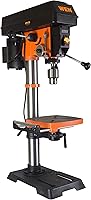
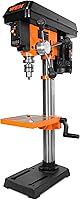
The WEN 4206T 8-Inch Drill Press has 5 speeds: 750, 1,100, 1,500, 2,100, and 3,200 RPM. It changes speed by moving the belt between pulley positions.
Read how to use a drill press for setup, workholding, and operating steps. If you are comparing machines, our best benchtop drill presses guide covers options with different speed ranges.
What signs tell you to slow down?
Burning, chatter, grabbing, or rough holes mean you should stop and check the setup before continuing. A lower speed may help in some cases, but these signs do not identify speed as the only cause.
A burning smell or dark marks can point to excess heat from a dull bit, packed chips, unsuitable speed, or feed pressure. Let the cutter stop fully and disconnect power before inspecting the bit or clearing debris by hand.
Chatter can mean the workpiece or table is loose, the bit is not secured, or the cutter is struggling. Check the clamps, table locks, bit condition, and cutter seating before restarting.
Don’t hold a small piece by hand under a rotating bit. Use clamps or a suitable vise, and secure the vise so the workpiece cannot turn or lift.
How do you choose a drill press for wood speeds?
Choose a press whose available RPM settings match your intended bits and whose capacity suits the work. Check individual settings as well as the low and high ends of its range.
The SKIL DP9505 10-Inch Drill Press offers 5 speeds from 610 to 2,800 RPM, an adjustable depth stop, and a work surface that tilts up to 45 degrees left and right. Compare that speed range with the guidance for your cutters.
For wide cutters, check whether the recommended speed is below the machine’s minimum. The drill press buying guide explains what else to consider for a home shop.
What speed should you use for clean holes in wood?
Start with the bit maker’s recommended RPM, secure the workpiece, and try a scrap test. Check the result before drilling the finished piece.
For clean entry and exit, keep the bit sharp and the work supported. A secured backing board can help reduce tear-out as the bit exits, while controlled feed pressure helps avoid forcing the cutter.
For deep holes, clear chips as the bit’s instructions require. Stop and disconnect power before inspecting the setup or clearing chips by hand, and follow the manual before changing speed.
Which drill press speed should you choose?
Choose a setting within your bit maker’s recommended range for the cutter diameter and wood. Small bits generally use higher speeds, while wide Forstner bits and hole saws often need lower RPM.
If your press cannot reach the required range, use a suitable machine or cutter rather than forcing a nearby setting. For setup steps, continue with how to use a drill press.
Frequently asked questions
What speed should I use on a drill press for wood?
Use the bit maker's recommended RPM for your bit type, diameter, and wood. Small bits generally use higher speeds than large cutters, but diameter alone does not give you a suitable setting.
Secure the workpiece and try scrap before drilling your finished piece.
Is a higher drill press speed better for wood?
No, a higher speed is not always better for wood. Small bits generally use higher speeds, while larger cutters often need lower RPM.
Follow the bit maker's guidance and stop if the bit grabs, burns, or chatters, then check speed, workholding, bit condition, and feed pressure.
What speed should I use for a Forstner bit in wood?
Use the Forstner bit maker's recommended RPM for the bit diameter and wood you are drilling. Larger bits generally need slower speeds, but there is no single setting for every cutter.
Clamp the workpiece, clear chips as instructed, and stop if the bit burns, grabs, or chatters.
How do I change drill press speed?
Follow your drill press manual because speed controls differ between machines. For belt changes, stop and unplug the press, move the belt as instructed, check its tension, and close the cover before reconnecting power.
Some variable-speed controls require a different procedure, so check before adjusting them.