7 Best Benchtop Drill Presses (October 2026)
The best benchtop drill presses include the WEN 4206T 8-Inch Drill Press for compact benches, the WEN 12-Inch Benchtop Drill Press for deeper drilling, and the WEN 10-Inch Benchtop Drill Press for frequent speed changes.
On this page (11 sections)
- Which benchtop drill presses stand out?
- How we compared these benchtop drill presses
- Compare benchtop drill press sizes and features
- Best benchtop drill presses by use
- How do you choose the best benchtop drill press?
- Will a benchtop drill press fit your workspace?
- How should you set up a new drill press?
- How do you get cleaner holes and repeatable depths?
- Which drill press mistakes should you avoid?
- What care does a benchtop drill press need?
- Which best benchtop drill press pick should you buy?
The WEN 4206T is the best benchtop drill press for a compact home shop that mainly drills small parts. Choose the WEN 12-inch for deeper holes and wider workpieces, or the WEN 10-inch when frequent speed changes matter more than extra drilling depth.
Start with the holes you need to make, rather than the largest motor you can fit. Reach, feed travel and room for clamps decide whether a press can handle your projects.
Our picks at a glance
-
1

-
2

-
3

- 4
 Check it
SKIL DP9505 10-Inch Drill Press
Best for guided project setup - 5
 Check it
VEVOR 12-Inch Benchtop Drill Press
Best for wider project parts - 6
 Check it
VEVOR 8-Inch Benchtop Drill Press
Best for small illuminated workspaces - 7
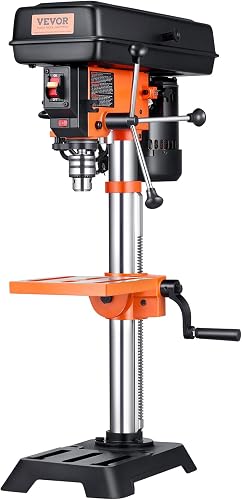 Check it
VEVOR 10-Inch Benchtop Drill Press
Best for occasional home projects
Which benchtop drill presses stand out?
The compact WEN leads for small-part work, while the larger WEN models suit buyers who need more reach or easier speed selection. SKIL adds a laser and light to a preset-speed setup, and the VEVOR picks offer alternatives for different bench layouts.
WEN 4206T 8-Inch Drill Press: Best for compact benches
- 8-inch swing
- 2-inch spindle travel
- 5 speeds from 750 to 3200 RPM
- 6.5 x 6.5 in tilting table
A compact choice for drilling small parts, brackets and shop fixtures. Its locking depth stop helps repeat hole depths, while the slotted table accepts work-holding clamps.
Pros
- Compact 23-inch height
- Locking depth stop
- Table bevels 45 degrees left and right
Cons
- Limited reach for holes far from an edge
- Speed changes require adjusting the belt
WEN 12-Inch Benchtop Drill Press: Best for deeper drilling
- 12-inch swing
- 3-1/8-inch spindle travel
- Variable speed from 580 to 3100 RPM
- Digital speed readout and laser
The strongest fit here for buyers who need more feed travel and room around the spindle. A roller extension, worklight and larger table help with workpiece setup.
Pros
- Longer spindle travel than the smaller WEN models
- Variable speed with digital readout
- Includes laser, overhead light and roller extension
Cons
- About 37-inch height needs bench clearance
- Larger frame needs a dedicated space
WEN 10-Inch Benchtop Drill Press: Best for frequent speed changes
- 10-inch swing
- 2-inch spindle travel
- Variable speed from 530 to 3100 RPM
- Digital speed readout and laser
A useful middle choice for switching between bit sizes and materials. It adds reach over an 8-inch press without moving to a 12-inch swing.
Pros
- Variable speed with digital readout
- Laser guide and adjustable depth stop
- Two-year warranty from WEN
Cons
- Less reach than the 12-inch models
- Same spindle travel as the compact WEN
SKIL DP9505 10-Inch Drill Press: Best for guided project setup
- 6.2-amp induction motor
- 5 speeds from 610 to 2800 RPM
- Laser alignment and LED worklight
- Adjustable depth stop
A five-speed choice with both a laser and worklight for setting up project parts. Its depth stop helps repeat blind holes, and the bump-off switch gives you a clear stop control.
Pros
- Laser and LED worklight
- Adjustable depth stop and bump-off switch
- Three-year limited warranty from SKIL
Cons
- Preset speeds instead of continuous adjustment
- Less reach than the 12-inch models
VEVOR 12-Inch Benchtop Drill Press: Best for wider project parts
- 12-inch swing
- Variable speed from 530 to 3140 RPM
- Digital readout and X-laser
- Tilting worktable and LED light
A choice for wider stock when variable speed and built-in lighting are priorities. Its weight and height favor a permanent bench location.
Pros
- Variable speed and digital readout
- X-laser and LED light
- More reach than the 8- and 10-inch picks
Cons
- 84.3-pound weight takes planning to move
- 37.4-inch height needs overhead clearance
VEVOR 8-Inch Benchtop Drill Press: Best for small illuminated workspaces
- 8-inch swing
- 2.5-amp induction motor
- 5 speeds from 750 to 3200 RPM
- LED worklight and tilting table
A compact-capacity press for small parts where light at the bit is useful. Its depth stop supports repeated hole depths, while belt-set speeds suit batches of similar work.
Pros
- Built-in LED worklight
- Adjustable depth stop
- Height-adjustable tilting table
Cons
- Limited reach for wide workpieces
- Speed changes require adjusting the belt
VEVOR 10-Inch Benchtop Drill Press: Best for occasional home projects
- 10-inch swing
- 3.2-amp induction motor
- 5 preset speeds
- Tilting worktable
A basic choice for occasional drilling when an 8-inch press lacks reach. Confirm the speed range with VEVOR if a particular bit requires a specific RPM.
Pros
- More reach than an 8-inch press
- Five speed settings
- Tilting worktable
Cons
- Preset speeds instead of continuous adjustment
- Exact speed range needs confirmation
How we compared these benchtop drill presses
We compared workpiece capacity, speed control and setup features for common home-shop jobs. The order favors a clear use for each machine, with the compact top pick aimed at smaller projects.
Reach and drilling depth carry more weight than a laser because they determine which holes you can make. Lighting, depth stops and speed displays then help you set up those holes.
Motor amperage alone cannot rank drilling performance across machines. Bit condition, cutting diameter, material and feed pressure all affect the work, so choose capacity around your regular jobs.
Compare benchtop drill press sizes and features
Compare swing and spindle travel first, then check speed range and table support. A machine can have enough reach for your hole while still needing extra support for the rest of the board.
| Product | Best for | Swing | Spindle travel | Speed range | Our score |
|---|---|---|---|---|---|
| WEN 4206T 8-Inch Drill Press | compact benches | 8 in | 2 in | 750–3200 RPM, 5 settings | 9.2 |
| WEN 12-Inch Benchtop Drill Press | deeper drilling | 12 in | 3-1/8 in | 580–3100 RPM, variable | 8.8 |
| WEN 10-Inch Benchtop Drill Press | frequent speed changes | 10 in | 2 in | 530–3100 RPM, variable | 8.3 |
| SKIL DP9505 10-Inch Drill Press | guided project setup | 10 in | 610–2800 RPM, 5 settings | 8.0 | |
| VEVOR 12-Inch Benchtop Drill Press | wider project parts | 12 in | 530–3140 RPM, variable | 7.8 | |
| VEVOR 8-Inch Benchtop Drill Press | small illuminated workspaces | 8 in | 2 in | 750–3200 RPM, 5 settings | 7.6 |
| VEVOR 10-Inch Benchtop Drill Press | occasional home projects | 10 in | 7.0 |
Best benchtop drill presses by use
Choose the press that solves your main capacity limit, then decide which controls you will use often. Each pick below has a clear buyer fit and a reason to move to another model.
WEN 4206T 8-Inch Drill Press: Best for compact benches
- 8-inch swing
- 2-inch spindle travel
- 5 speeds from 750 to 3200 RPM
- 6.5 x 6.5 in tilting table
A compact choice for drilling small parts, brackets and shop fixtures. Its locking depth stop helps repeat hole depths, while the slotted table accepts work-holding clamps.
Pros
- Compact 23-inch height
- Locking depth stop
- Table bevels 45 degrees left and right
Cons
- Limited reach for holes far from an edge
- Speed changes require adjusting the belt
The WEN 4206T suits brackets, small wooden parts and shop fixtures when bench space is tight. At 23 inches tall with a 7 x 11 in base, it is a practical starting point for a fixed drilling station.
Its 6.5 x 6.5 in table gives small parts a place to sit, with slots for clamps or a secured vise. Add support for long stock so its weight cannot pull the piece out of position.
The locking depth stop is useful for batches of shallow holes, such as recesses that must stop before reaching the underside. Set it using scrap of the same thickness before drilling the project pieces.
Choose this press if most of your holes sit near an edge and you can group work by speed. Skip it if wide panels, deep bores or frequent belt changes would interrupt your usual projects.
Our WEN 4206T drill press review takes a closer look at this compact option.
WEN 12-Inch Benchtop Drill Press: Best for deeper drilling
- 12-inch swing
- 3-1/8-inch spindle travel
- Variable speed from 580 to 3100 RPM
- Digital speed readout and laser
The strongest fit here for buyers who need more feed travel and room around the spindle. A roller extension, worklight and larger table help with workpiece setup.
Pros
- Longer spindle travel than the smaller WEN models
- Variable speed with digital readout
- Includes laser, overhead light and roller extension
Cons
- About 37-inch height needs bench clearance
- Larger frame needs a dedicated space
The WEN 12-inch is the better fit for buyers who need more drilling travel in one feed stroke. Its 3-1/8-inch spindle travel gives more room to advance the bit than either smaller WEN here.
That helps with thicker parts, although the bit's usable cutting length still limits the hole. You also need enough clearance to fit the bit, workpiece and any fixture beneath the chuck.
A 9.5 x 9.5 in table and roller extension help support work during setup. The roller does not replace separate support for a long board or an awkward assembly.
The 5/8-inch keyed chuck accepts larger shanks than the smaller WEN chucks. Check the cutting diameter and required RPM too, since fitting a bit into the chuck is only one part of matching it to the press.
Buy this model for a permanent station with room to grow. Skip it if your work stays small and its taller frame would crowd shelves or make the controls uncomfortable to reach.
WEN 10-Inch Benchtop Drill Press: Best for frequent speed changes
- 10-inch swing
- 2-inch spindle travel
- Variable speed from 530 to 3100 RPM
- Digital speed readout and laser
A useful middle choice for switching between bit sizes and materials. It adds reach over an 8-inch press without moving to a 12-inch swing.
Pros
- Variable speed with digital readout
- Laser guide and adjustable depth stop
- Two-year warranty from WEN
Cons
- Less reach than the 12-inch models
- Same spindle travel as the compact WEN
The WEN 10-inch fits buyers who switch between drilling tasks often but do not need the larger WEN's feed travel. Its mechanical variable-speed control and digital readout make it easier to choose and return to an RPM.
That suits a project involving several bit diameters, where each step may need a different speed. Follow WEN's instructions for operating the adjustment lever rather than treating it like a belt-change system.
The 8 x 7.5 in table gives more surface area than the compact WEN's table. Its laser helps you approach a marked center, but final alignment should come from the bit tip and your layout mark.
At about 34 inches tall, this still needs a planned bench position. Check room for the feed handles, your clamping setup and stock extending beyond the table.
Choose it for varied home-shop work. Skip it if deeper holes are the reason you are replacing a smaller press, since its spindle travel remains 2 inches.
SKIL DP9505 10-Inch Drill Press: Best for guided project setup
- 6.2-amp induction motor
- 5 speeds from 610 to 2800 RPM
- Laser alignment and LED worklight
- Adjustable depth stop
A five-speed choice with both a laser and worklight for setting up project parts. Its depth stop helps repeat blind holes, and the bump-off switch gives you a clear stop control.
Pros
- Laser and LED worklight
- Adjustable depth stop and bump-off switch
- Three-year limited warranty from SKIL
Cons
- Preset speeds instead of continuous adjustment
- Less reach than the 12-inch models
The SKIL DP9505 suits buyers who want a light and alignment guide without continuous speed adjustment. Its LED worklight helps reveal the bit tip, layout marks and the edges of a recess during setup.
The laser is a positioning aid rather than a substitute for marking the work. Lower the stationary bit toward your mark to confirm alignment before starting the motor.
Its adjustable depth stop is useful for repeated blind holes, while the bump-off switch gives you a stop control to locate before drilling. Arrange clamps and stock so they do not block access to it.
SKIL backs this press with a three-year limited warranty. Read the terms when comparing support, rather than assuming every part and situation has the same coverage.
Pick it for project work where five speed choices cover your bits. Skip it if you regularly need an RPM between those settings or want a readout to track speed changes.
VEVOR 12-Inch Benchtop Drill Press: Best for wider project parts
- 12-inch swing
- Variable speed from 530 to 3140 RPM
- Digital readout and X-laser
- Tilting worktable and LED light
A choice for wider stock when variable speed and built-in lighting are priorities. Its weight and height favor a permanent bench location.
Pros
- Variable speed and digital readout
- X-laser and LED light
- More reach than the 8- and 10-inch picks
Cons
- 84.3-pound weight takes planning to move
- 37.4-inch height needs overhead clearance
The VEVOR 12-inch suits wider project parts at a permanent station. Its swing provides room to place holes farther from an edge than the smaller picks, while variable speed helps with changes in bit size.
The digital readout, X-laser and LED light support setup in different ways. Use the display to track RPM, the laser for rough positioning and the light to see the actual cutting area.
Its table adjusts in height and tilts left or right for angled work. Secure a tilted workpiece against sliding before bringing the bit down, and check that clamps clear the full feed path.
At 84.3 pounds and 37.4 inches tall, this press needs a suitable bench and a safe plan for lifting it into place. A layout that requires regular relocation is a poor match.
Choose it when reach and speed adjustment are your priorities. If deeper holes drive the purchase, the WEN 12-inch gives you a stated spindle-travel figure to plan around.
VEVOR 8-Inch Benchtop Drill Press: Best for small illuminated workspaces
- 8-inch swing
- 2.5-amp induction motor
- 5 speeds from 750 to 3200 RPM
- LED worklight and tilting table
A compact-capacity press for small parts where light at the bit is useful. Its depth stop supports repeated hole depths, while belt-set speeds suit batches of similar work.
Pros
- Built-in LED worklight
- Adjustable depth stop
- Height-adjustable tilting table
Cons
- Limited reach for wide workpieces
- Speed changes require adjusting the belt
The VEVOR 8-inch is worth considering for small parts where light at the bit matters. Its integrated LED worklight helps when your body or the press head casts a shadow over the work.
An adjustable depth stop supports repeated recesses, and the height-adjustable table lets you arrange the work beneath the bit. The tilting table also allows angled drilling with suitable clamping.
This model uses belt changes to select among five speeds. It makes most sense when you can finish a batch at one setting before changing to another bit or material.
Its 25.4-pound weight is relevant if you must lift the machine into position, but it still needs secure mounting for use. Keep the bench area clear enough to clamp parts without working around stored tools.
Choose it for compact-capacity drilling with built-in lighting. Skip it if your planned hole locations already push beyond an 8-inch press's reach, since a brighter work area cannot solve that limit.
VEVOR 10-Inch Benchtop Drill Press: Best for occasional home projects
- 10-inch swing
- 3.2-amp induction motor
- 5 preset speeds
- Tilting worktable
A basic choice for occasional drilling when an 8-inch press lacks reach. Confirm the speed range with VEVOR if a particular bit requires a specific RPM.
Pros
- More reach than an 8-inch press
- Five speed settings
- Tilting worktable
Cons
- Preset speeds instead of continuous adjustment
- Exact speed range needs confirmation
The VEVOR 10-inch suits occasional projects that need more reach than an 8-inch machine provides. It offers a 3.2-amp induction motor, five preset speeds and a tilting worktable.
The included table crank handle helps distinguish its setup from a simple fixed-height work surface. Check access to the crank and table lock when planning where the press will sit.
Its 28.7-inch height and 41.9-pound weight are useful starting points for arranging a bench station. Leave working room beyond the machine itself for long parts and clamps.
Confirm the exact speed range with VEVOR before ordering if a particular bit requires a specific RPM. That detail matters more than the number of speed settings when your work includes larger cutters.
Choose this model for basic drilling with occasional setup changes. Skip it if continuous speed adjustment is central to your work, or if you need a clearly matched low-speed setting for a planned cutting task.
How do you choose the best benchtop drill press?
Choose by hole location, hole depth and bit requirements, in that order. Then check whether the machine and its work-holding setup fit your bench.
Before comparing extras, write down your widest regular workpiece, deepest planned hole and largest cutting diameter. These give you a more useful shortlist than motor size alone.
How much reach does your benchtop drill press need?
An 8-inch swing gives 4 inches from the spindle center to the column. A 10-inch swing gives 5 inches, and a 12-inch swing gives 6 inches.
Measure from the planned hole center to the edge that will face the column. Include any fence or fixture that takes up space behind the workpiece.
Swing does not set a strict limit on board length. A long, narrow rail may fit easily, while a hole near the center of a broad panel may be out of reach.
Do not plan to solve a reach problem by tilting or loosely supporting the stock. Choose a larger press or a different drilling method when the work cannot sit flat and secure.
How much spindle travel and vertical clearance do you need?
Spindle travel is the distance the bit can move downward during the feed stroke. Vertical clearance is the space available for the bit, stock and work-holding beneath the chuck.
You need both measurements to plan deep holes. A long bit may reach the bottom, yet leave too little room to place a thick workpiece under it.
A vise, auxiliary table or angled fixture also consumes clearance. Think through the complete stack rather than measuring only the bare workpiece.
For blind holes, include the bit's pointed tip when setting depth. A recess with a flat bottom and a twist-bit hole do not leave the same shape beneath the surface.
Are preset speeds or variable speed better?
Preset speeds suit repeated batches with a few familiar bits. Variable speed earns its place when you often change cutting diameter or material.
Focus on the lowest usable speed as well as the top speed. Large wood-boring bits and many metal-drilling jobs need slower rotation than small twist bits.
A larger chuck does not make every large cutter suitable. Reduced-shank bits can fit the chuck while still requiring a slower speed or more cutting force than the job allows.
Use our drill press speed chart for wood to plan common wood-drilling tasks. Follow the bit manufacturer's limits when they differ from a general chart.
Which table features will you use?
Table size affects how much stock rests directly beneath the bit. Slots, clamp access and room for a fixture often matter more than the table's bare dimensions.
A depth stop is useful for matching recesses, but it does not measure the work for you. Different stock thicknesses can leave different amounts of material beneath the same depth setting.
A laser helps position the work, while a light helps you see it. Neither holds the workpiece or corrects a table that is out of square.
For angled holes, think about how you will stop the stock from sliding down the tilted surface. A secure fixture can matter more than the tilt scale.
Will a benchtop drill press fit your workspace?
Plan for the machine plus the work moving around it, rather than the base alone. A press tucked tightly into a corner can be hard to use with long stock.
Measure overhead clearance for the head, covers and any access needed for maintenance. Check that shelves do not block speed changes or leave you reaching awkwardly around the machine.
Bench height matters too. You should be able to see the layout mark, use the feed handle and reach the stop switch without leaning across the rotating area.
Choose a bench that can carry the press, fixtures and workpiece without rocking. Follow the machine's mounting instructions instead of relying on weight to hold it in place.
Leave room for support stands when drilling long boards. Our guide to benchtop workshop machines for a small shop can help you plan shared working space.
How should you set up a new drill press?
Start with secure mounting, correct assembly and a square table. These steps affect every hole you make afterward.
Mount and assemble it before fitting a bit
Follow the manual's lifting, assembly and mounting sequence. Use suitable help or lifting equipment when the machine's weight makes positioning difficult.
Clean and fit the chuck as directed, keeping mating surfaces free of debris. Remove the chuck key immediately after tightening and use its storage location if the machine has one.
With power disconnected, check that fasteners, table locks and guards are secure. Turn the spindle by hand only as the manual permits to check clearance around your setup.
Check square and set the working height
Use a straight reference in the chuck and a suitable square to check the table's relationship to the spindle. Do not assume the zero mark on a tilt scale is exact.
Position the table so the bit can start above the work and reach the required depth. Lock it before drilling, and confirm that a through-hole will not send the bit into the metal table.
Place a flat sacrificial backer beneath wood when appropriate. It supports the exit side and protects the table, but it must be secured along with the workpiece.
Secure the work and rehearse the feed path
Clamp small parts or hold them in a drill-press vise that is itself secured to the table. A loose vise can rotate with a caught bit.
A general bench vise has a different role from a table-mounted drilling vise. Our bench vise guide helps if you also need a separate station for filing, bending or assembly.
With the motor off, lower the bit toward the mark and check the full feed path. Make sure the chuck, handles and bit cannot strike a clamp or fixture.
How do you get cleaner holes and repeatable depths?
Use a sharp, suitable bit, secure work-holding and controlled feed pressure. A drill press guides the bit, but it cannot compensate for a dull edge or moving stock.
For repeated hole locations, use a clamped fence and stop block where the work shape allows. Keep chips from collecting against those reference surfaces, or later pieces may sit in a different position.
For repeated depths, set the stop on matching scrap and check the result. Measure from the correct reference surface, especially when the project includes parts of different thicknesses.
Back off the feed as a through-hole breaks through. Sudden grabbing at the exit can damage the edge or try to spin the workpiece.
Deep holes need chip clearance. Retract the bit as appropriate for the bit and material, rather than forcing it down while the flutes are packed.
For metal, choose a suitable bit and any cutting lubricant recommended for the material. Keep chips away from your fingers and remove them with a brush after the spindle stops.
Our guide to using a drill press explains the operating sequence in more detail.
Which drill press mistakes should you avoid?
Avoid unsecured stock, unsuitable speed and rushed adjustments. These mistakes can spoil a hole even when the press has enough capacity.
- Holding a small part by hand: Clamp it before starting because a caught bit can spin the part.
- Leaving the chuck key in place: Remove it as soon as the bit is tightened, before reaching for the switch.
- Changing belts with power connected: Stop and unplug the press before opening the belt cover or moving a belt.
- Misusing a variable-speed lever: Follow the model's instructions, since some mechanical systems require adjustment while running.
- Forcing a stalled cut: Stop and check speed, bit sharpness, chip clearance and work-holding before continuing.
- Treating a laser as final alignment: Check the stationary bit against the actual mark.
- Using the chuck for side cutting: Ordinary drilling presses are not a substitute for a milling machine.
Wear eye protection and secure loose hair, jewelry and clothing. Keep gloves away from rotating parts, and wait for the spindle to stop before clearing the work area.
What care does a benchtop drill press need?
Keep chips off the table, bare metal dry and moving parts maintained as the manual directs. A short cleanup after each job makes the next setup easier.
Disconnect power before cleaning or maintenance. Brush away chips, wipe away moisture and use a suitable rust protectant on exposed metal without contaminating gripping or chuck-mounting surfaces.
Inspect belts for wear and check tension according to the manual. Excess tension can create problems just as a slipping belt can, so avoid tightening by guesswork.
If vibration or hole quality changes, check the bit, its seating and the machine's fasteners before changing your technique. Stop using the press if the chuck loosens, a guard is damaged or the controls behave unexpectedly.
Which best benchtop drill press pick should you buy?
Choose the WEN 4206T for small parts on a compact bench. Move to the WEN 12-inch when deeper drilling or holes farther from an edge are regular needs.
The WEN 10-inch is the best benchtop drill press choice here for frequent speed changes without stepping up to a 12-inch swing. Pick the SKIL if preset speeds cover your work and you want both a laser and light.
Consider the VEVOR models when their reach, controls and bench requirements fit your projects. Before ordering, sketch one demanding setup with its bit, clamps and support so you can spot a capacity problem early.
Use our drill press buying guide to check that setup against the size of press your shop needs.
Our top 3 picks at a glance
-
1
-
2
-
3
Frequently asked questions
What size benchtop drill press should I get?
Choose the smallest press that reaches your planned hole locations and leaves room for your bit, stock and clamps. An 8-inch model suits small parts, while a 10- or 12-inch model reaches farther from an edge.
Check spindle travel separately if you need deep holes.
Is variable speed useful on a benchtop drill press?
Variable speed is useful when you often change bit sizes or materials because you can choose RPM between fixed settings. A digital readout makes that setting easier to track.
Follow the machine's instructions for speed adjustment, since a mechanical variable-speed control may need the motor running.
What does drill press swing mean?
Swing is twice the distance from the spindle center to the column, so a 12-inch swing gives 6 inches of reach. It describes the round workpiece diameter you can drill at its center.
Long or irregular parts can still fit when their hole positions clear the column.
Can a benchtop drill press drill angled holes?
Yes, a tilting table lets you drill angled holes when the workpiece is securely clamped. Check the angle with a suitable measuring tool, lock the table and confirm that the bit clears the clamps.
Return the table to square afterward so the next job starts from a known position.
How do I choose drill press speed for wood?
Choose speed by bit type, bit diameter and wood species, starting with the bit manufacturer's guidance. Larger cutting diameters generally need lower RPM, even when the shank fits a small chuck.
Our drill press speed chart for wood helps you plan common jobs before setting the machine.


