7 Best Benchtop Band Saws (October 2026)
The best benchtop band saws include the SKIL BW9501 9-Inch Benchtop Band Saw for frequent setup changes, the WEN BA3962 10-Inch Band Saw for taller resaw work, and the Woodskil 9-Inch Benchtop Band Saw for small mixed projects.
On this page (9 sections)
- Which best benchtop band saw pick fits your work?
- Benchtop band saws compared by use
- How do you choose the right cutting capacity?
- Which blade should you use for curves and resawing?
- Which table features help with real projects?
- How should you set up a benchtop band saw?
- What mistakes spoil cuts on a small band saw?
- How do dust collection and care affect daily use?
- Which best benchtop band saw should you choose?
The best benchtop band saw for most small shops is the SKIL BW9501, because its tensioning and table controls suit frequent changes between woodworking tasks. Pick the WEN BA3962 instead when taller resaw work is the main reason you're buying.
The right saw must fit both your stock and your workspace. A larger model name or higher amp figure won't help if the board can't clear the upper guide or turn past the frame.
If you're comparing this tool with a scroll saw, start with our band saw vs scroll saw comparison. For other equipment in a compact shop, see our benchtop workshop machines guide.
Our picks at a glance
-
1
 Best for frequent setup changes
SKIL BW9501 9-Inch Benchtop Band Saw
8.4/10 our score
See it on Amazon -
2

-
3

- 4
 Best for specific-model replacementsCheck it
- 5
 Check it
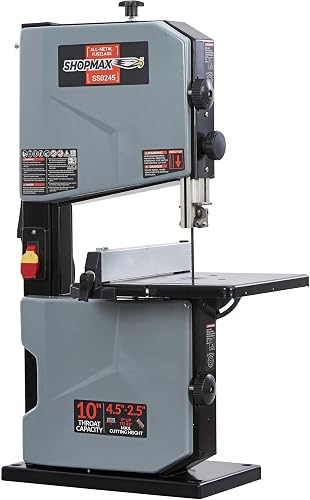
ShopMax 10-Inch Benchtop Band Saw
Best for wider project blanks - 6
 Best for warranty-focused buyersCheck it
- 7
 Check it
Seesii 8-Inch Benchtop Band Saw
Best for compact craft parts
Which best benchtop band saw pick fits your work?
Choose SKIL for frequent adjustments, WEN for taller boards, or JET for warranty coverage when its smaller capacity fits your projects. Woodskil suits mixed small work, ShopMax favors wider blanks, and Seesii fits compact craft parts.
The Ryobi is a narrower recommendation for buyers seeking that exact model. Its essential cutting limits and included accessories need confirmation before it belongs on a project-based shortlist.
CivilCupboard compared cutting capacity, blade options, controls, accessories and space needs. The scores reflect those features and their usefulness for small-shop woodworking.
| Product | Best for | Model | Motor | Dust port | Our score |
|---|---|---|---|---|---|
| SKIL BW9501 9-Inch Benchtop Band Saw | frequent setup changes | BW9501-00 | 2.8 amp induction | Accepts standard 2 1/2 in vacuum hoses | 8.4 |
| WEN BA3962 10-Inch Band Saw | taller resaw work | 7.9 | |||
| Woodskil 9-Inch Benchtop Band Saw | small mixed projects | 7.6 | |||
| Ryobi BS904G 9-Inch Band Saw | specific-model replacements | BS904G | 7.5 | ||
| ShopMax 10-Inch Benchtop Band Saw | wider project blanks | 4.2 amp induction | 7.0 | ||
| JET 9-Inch Benchtop Band Saw | warranty-focused buyers | 7.0 | |||
| Seesii 8-Inch Benchtop Band Saw | compact craft parts | 350 watts, 120 volts | 6.8 |
Benchtop band saws compared by use
Match each saw to the cuts you repeat most often, rather than buying around one occasional project. A saw that fits your routine stock and is easy to keep ready will serve you better than unused capacity.
SKIL BW9501 9-Inch Benchtop Band Saw: Best for frequent setup changes
- 2.8 amp induction motor
- Two-speed drive with tool-free belt tensioning
- Quick blade tension setting
- Rack-and-pinion table adjustment
Quick blade tension setting and rack-and-pinion table adjustment suit a shop that switches between curves, straight cuts and bevel work.
Pros
- Two-speed drive
- Tool-free belt tensioning
- Miter gauge included
Cons
- Check cutting height against taller stock
- Verify replacement blade length before buying blades
The SKIL BW9501 is the strongest all-around choice here for a shop that moves between curved parts, straight cuts and bevel work. Its quick blade tension setting and rack-and-pinion table adjustment address steps you'll repeat when changing tasks.
The two-speed drive has tool-free belt tensioning, while ball-bearing and lower blade guides support blade tracking. A sight window helps you check blade position, but doesn't replace the tracking procedure in the manual.
Its 2.8 amp induction motor, steel base and included miter gauge round out the package. The dust port accepts standard 2 1/2-inch vacuum hoses, which is useful if that matches your existing equipment.
Choose SKIL when convenient adjustments matter more than buying around a known maximum resaw height. Skip it for a capacity-first purchase until you've verified cutting clearance and the correct replacement blade length for your planned work.
WEN BA3962 10-Inch Band Saw: Best for taller resaw work
- Cuts up to 6 in deep and 9 3/4 in wide
- Two speeds: 1,520 or 2,620 FPM
- Includes stand and work light
- Table bevels up to 45 degrees
The deepest specified cutting capacity in this group suits taller boards. An included stand frees bench space but needs its own floor area.
Pros
- 6-inch maximum cutting depth
- Stand and work light included
- Fence and miter gauge included
Cons
- Needs dedicated floor space with the stand
- Maximum cutting height still requires suitable blade and feed rate
The WEN BA3962 is the best fit here for taller resaw work, with clearance for cuts up to 6 inches deep and 9 3/4 inches wide. That added height matters when you stand a board on edge to slice it into thinner pieces.
It accepts 72-inch blades from 1/8 to 1/2 inch wide, giving you blade-width options for curves and straighter work. Its two operating speeds are 1,520 and 2,620 FPM.
WEN includes a stand, work light, fence, miter gauge and 3-in-1 dust port. The cast-aluminum table measures 14 1/8 x 12 1/2 inches and bevels up to 45 degrees.
Choose it when the added cutting height will get regular use. Skip it if you can't spare floor space for its 26.5 x 21 x 58.5-inch overall dimensions; our small woodworking shop setup guide helps plan the surrounding work zone.
Woodskil 9-Inch Benchtop Band Saw: Best for small mixed projects
- 3 1/2 in maximum cutting depth
- 9 in maximum cutting width
- Table tilts from 0 to 45 degrees
- Fence and miter gauge included
A tilting cast-aluminum table, fence and miter gauge cover straight, curved and angled cuts in smaller stock.
Pros
- Fence and miter gauge included
- Steel base
- 2 1/2-inch dust exhaust port
Cons
- Limited height for taller resaw projects
- Maximum blade width is 3/8 inch
The Woodskil suits a hobby shop making small parts with mixed straight, curved and angled cuts. Its fence and miter gauge give you guides for different tasks without choosing the saw around resawing alone.
Maximum cutting capacity is 3 1/2 inches deep and 9 inches wide. The cast-aluminum table measures 12 5/16 x 11 7/8 inches and tilts from 0 to 45 degrees for bevel work.
It uses 59 1/2-inch blades from 1/8 to 3/8 inch wide. A steel base and 2 1/2-inch dust exhaust port complete a practical feature set for a fixed bench location.
Buy it when your projects stay within those limits and you want the included guides for routine work. Skip it for taller resaw boards, and check blade selection before planning tight curves: a tilting table doesn't change the turning radius a blade can handle.
Ryobi BS904G 9-Inch Band Saw: Best for specific-model replacements
- 9-inch band saw model
- 62-inch blade length
- 45-degree cutting angle
Consider the BS904G when you want this exact model. Confirm cutting capacity, accessories and warranty coverage before committing.
Pros
- Corded electric power
- 62-inch blade length
Cons
- Cutting capacity needs confirmation
- Included accessories need confirmation
The Ryobi BS904G makes sense mainly for someone seeking this exact replacement model. If you're choosing your first saw by project needs, the other options offer clearer capacity details for comparison.
The BS904G uses a 62-inch blade and has a 45-degree cutting angle. It's corded electric and weighs 37.3 lb, so plan a secure working position rather than treating it as a loose portable tool.
Before committing, confirm maximum cutting height, throat clearance, included guides and warranty coverage. Those details determine whether your planned board fits and what else you'll need to get started.
Choose it if familiarity with the BS904G is useful and you can verify its fit for your work. Skip it when you need a fully defined purchase plan now; don't assume another Ryobi model's accessories or replacement parts fit this one.
ShopMax 10-Inch Benchtop Band Saw: Best for wider project blanks
- 4.2 amp induction motor
- Cuts up to 4.5 in deep and 10 in wide
- Table adjusts up to 45 degrees
- Steel construction
The widest specified cutting capacity here suits broader blanks, with more cutting height than the smaller Woodskil, JET and Seesii options.
Pros
- 10-inch maximum cutting width
- Steel construction
- 12 x 12-inch worktable
Cons
- Dust extractor sold separately
- Assembly required
- 54.7 lb weight makes frequent moves less appealing
The ShopMax is worth choosing for wider project blanks, with a maximum cutting width of 10 inches and cutting depth of 4.5 inches. Its 4.2 amp induction motor and steel construction suit a buyer planning a permanent shop position.
The 12 x 12-inch table adjusts up to 45 degrees. It uses a 67.4-inch blade, with supported widths from 0.14 to 0.47 inch, so check replacement blade availability before building your tool plan around it.
At 54.7 lb, it is less appealing for frequent moves between storage and a bench. It comes partially assembled with a hardware bag, so allow time for assembly and adjustment.
Choose ShopMax when its width and middle-ground cutting height match your blanks. Skip it for regular tall resaw work beyond its clearance, and check hose compatibility because its dust connector is designed for a separately sold ShopMax extractor.
JET 9-Inch Benchtop Band Saw: Best for warranty-focused buyers
- 5-year warranty on woodworking machinery
- 3 1/2 in resaw capacity
- Table tilts from 0 to 45 degrees
- 2 1/2 in dust port
JET suits smaller woodworking projects when warranty length matters. It bolts to a bench or stand and includes a fence and miter gauge.
Pros
- JET backs woodworking machinery with a 5-year warranty
- Fence and miter gauge included
- Cast aluminum wheels
Cons
- Mounting hardware not included
- Resaw capacity limits taller stock
The JET suits a buyer whose projects fit a smaller saw and who puts weight on warranty length. JET backs its woodworking machinery with a 5-year warranty, but capacity should still decide whether it belongs in your shop.
Its 9-inch throat and 3 1/2-inch resaw capacity suit smaller wood and wood-composite work. Cast aluminum wheels, precision blade guides and an adjustable blade tension system support blade setup.
The table tilts from 0 to 45 degrees, with two lock knobs. A fence and miter gauge are included, and a 2 1/2-inch dust port connects to a shop vacuum or dust collector.
The 40 lb saw measures 19 x 14 1/8 x 29 inches; mounting bolts, washers and nuts are extra. Skip it if taller boards drive the purchase, and account for JET's recommended 15 amp circuit when planning its location.
Seesii 8-Inch Benchtop Band Saw: Best for compact craft parts
- 8 in cutting width
- 3 1/8 in maximum cutting height
- Table tilts from 0 to 45 degrees
- Miter gauge and double-sided fence
The compact body suits small craft work, while the steel table, double-sided fence and miter gauge support several cutting tasks.
Pros
- 17 x 12-inch footprint
- Tool-free cutting-height control
- Fence and miter gauge included
Cons
- Narrowest specified cutting width here
- Lowest specified maximum cutting height here
The Seesii is a sensible fit for compact craft parts when you want straight cuts, open curves and occasional bevels. Its 8-inch cutting width and 3 1/8-inch maximum cutting height are the smallest specified limits in this group.
A 12 x 12-inch steel table tilts from 0 to 45 degrees, and the package includes a miter gauge and double-sided fence. Tool-free cutting-height control helps you set the upper assembly for different stock thicknesses.
The body measures 17 x 12 x 27 inches, and its 350-watt motor uses 120-volt power. A dust port provides a connection point for extraction.
Choose it when most workpieces are small enough to turn freely within the frame. Skip it if you expect to move into larger blanks soon, or if your main goal is enclosed decorative cutouts that call for a scroll saw.
How do you choose the right cutting capacity?
Choose cutting height and throat clearance from actual workpieces, not the size in a model name. Make a short list of the boards, blanks and patterns you expect to cut most often.
What capacity does the best benchtop band saw need?
For resawing, measure the board's width when it stands on edge: that becomes the height the saw must clear. For flat work, measure the stock thickness and the distance between the blade path and the frame.
Throat clearance limits how far the cut can sit from the frame-side edge of the workpiece. It also affects whether a shaped blank can rotate through a curved cut without hitting the saw.
A board that barely fits under the guide leaves little room for a carrier or jig. Include those supports in your measurements, especially if the stock can't rest securely on its own.
When should you move beyond a benchtop saw?
Move beyond this class when large resaw boards or long, heavy stock are routine. Maximum clearance tells you what physically fits, while blade choice, wood hardness and feed rate affect how the cut proceeds.
Don't buy for one oversized project if it makes every ordinary task harder to fit into your shop. Consider having that occasional board cut elsewhere, then size your saw for the work you actually repeat.
Which blade should you use for curves and resawing?
Use a narrower blade for tighter curves and a suitable wider blade for straighter work, within the saw's approved range. Blade length must match the machine exactly; nominal saw size isn't a replacement-blade measurement.
Match blade width to the turn
A wide blade resists turning sharply, so forcing it around a tight pattern can bend or twist it. Choose blade width using the blade maker's minimum-radius guidance.
For curves tighter than the installed blade can follow, make relief cuts through waste where appropriate. These give waste pieces somewhere to fall away and reduce the need to force the work around the blade.
Match tooth spacing to stock thickness
Thicker stock generally needs room between teeth to carry sawdust out of the cut. Fine teeth suit thinner material, but a blade with too little chip space can struggle as the cut gets deeper.
Follow blade guidance for the material and thickness. A saw that feeds poorly may need a different or sharper blade rather than more pressure on the board.
Treat speed as a material setting
Use the speed recommended by the machine and blade instructions. Motor RPM and blade speed in feet per minute are different measurements, so don't compare those numbers as if they describe the same thing.
Two speeds don't turn a woodworking saw into a general metal-cutting machine. Only cut a material when the saw's instructions allow it and you have a blade and operating speed suited to it.
Which table features help with real projects?
Choose a fence for repeat straight cuts, a miter gauge for supported crosscuts and a tilting table for bevels. Each helps with a different movement, so one accessory doesn't replace the others.
Check the table with a square before relying on its angle scale. For bevel work, also check that the stock clears the guides and stays supported as the table tilts.
A small table can support a surprisingly long board when properly placed infeed and outfeed supports share the load. Set supports level with the table so the board doesn't tip or steer away from the intended line.
For tiny parts, keep the blank larger during cutting and separate the finished piece later when practical. If fine interior shapes are your main task, a scroll saw for beginners is a better starting point.
How should you set up a benchtop band saw?
Set up the mounting, blade and guides before judging cut quality. Work through the manual's sequence with the machine unplugged, since changing one setting can affect the next.
Secure the saw and plan the cut path
Bolt the machine to a suitable bench or stand as directed. A bench that rocks or flexes under the saw needs attention before you start cutting.
Leave room ahead of and behind the blade for your longest normal stock. Keep access to wheel doors and adjustment controls, and route the dust hose where it won't pull against the machine or catch the work.
Install, tension and track the blade
Check that the blade is the correct size, seated properly and facing the correct cutting direction. Set tension using the machine's instructions rather than guessing from how tight the blade feels.
Adjust tracking before setting the guides. Our band saw tuning guide explains how tracking, guide clearance and table alignment work together.
Set guides for the stock
Position the upper guide assembly just above the workpiece, allowing the clearance the manual calls for. Leaving it raised far above thin stock exposes more blade and reduces nearby support.
Set side guides and thrust bearings to the specified clearances. Don't use them to push a poorly tracked blade into position.
Make a trial cut in scrap
Use scrap of similar thickness to check the line, feed rate and fence alignment. Keep the stock flat on the table and let the teeth remove material without forcing the cut.
If the blade wanders, stop and check sharpness, tooth choice, tension and alignment. Adjusting the fence around an underlying blade problem can make the next cut harder to diagnose.
What mistakes spoil cuts on a small band saw?
The most common avoidable problems come from forcing the feed, asking a blade to turn too tightly and leaving stock unsupported. Correct the cause instead of trying to steer harder.
Pushing too fast can bow the blade and spoil the cut below the visible surface. Slow down if the motor labors, sawdust stops clearing or the blade starts deflecting.
Don't twist the board to force a sudden turn. Back out only as the manual permits; if the blade binds, stop the machine and wait for it to stop before freeing the work.
Round stock needs a suitable cradle or jig to prevent rolling. A fence alone doesn't stop a dowel or irregular branch from rotating into the blade.
During resawing, keep a stable reference face against the fence and allow extra thickness for smoothing the cut surfaces. Don't expect the sawn face to be ready for final assembly.
Keep fingers out of the blade path, use suitable push aids and wait for a complete stop before clearing scraps. Wear eye and hearing protection, and secure loose clothing and hair.
How do dust collection and care affect daily use?
Connect suitable dust extraction and keep the blade path clean so debris doesn't interfere with normal operation. Plan collection before assigning the saw a permanent place.
Check hose diameter, adapters and clearance behind the machine. Our guide to the best dust collectors for a small shop can help you plan extraction around several woodworking tools.
A dust port won't capture every particle. Follow the equipment instructions for extraction and protective equipment, especially when cutting materials that create fine dust.
With the saw unplugged, remove packed sawdust from accessible areas using the method in the manual. Inspect the blade, wheel tires, guides and any wheel brush for wear or buildup.
Replace a damaged or dull blade rather than compensating with extra tension or feed pressure. Follow the manual's storage guidance, including whether to release blade tension, and keep the table clean and dry.
Which best benchtop band saw should you choose?
Choose the SKIL for a varied small-shop workload when its verified clearance fits your stock. Choose the WEN when taller resaw boards justify dedicated floor space, or ShopMax when wider blanks matter more than maximum cutting height.
Woodskil is a practical fit for mixed small projects, while JET suits similar-sized work with warranty length as a priority. Seesii fits compact craft parts; reserve the Ryobi for a deliberate purchase of that exact model.
Before ordering, write down your largest routine workpiece, the replacement blade size and where the machine will be secured. Those three checks will narrow your choice more usefully than motor size alone.
If your real goal is pierced patterns and tight interior cuts, compare the best scroll saws before choosing a benchtop band saw.
Our top 3 picks at a glance
-
1
Best for frequent setup changes
SKIL BW9501 9-Inch Benchtop Band Saw
8.4/10 our score
See it on Amazon -
2
-
3
Frequently asked questions
What size benchtop band saw should I buy?
Buy enough cutting height and throat clearance for your normal workpieces, with room to guide them through the cut. The size in the model name isn't the same as resaw capacity.
Measure your stock in its cutting position, including any jig, before choosing a saw.
Can a benchtop band saw resaw lumber?
Yes, a benchtop band saw can resaw boards that fit its cutting height, using a suitable blade and controlled feed rate. Start with a flat reference face and an edge that rests securely on the table.
Allow extra thickness for cleaning up saw marks afterward.
Is a band saw better than a scroll saw for curves?
A band saw is better suited to broader curves, thicker stock and work that also includes ripping or resawing. A scroll saw is the better choice for tight detail and enclosed interior cutouts.
Use our band saw vs scroll saw guide to match the tool to your projects.
How much space does a benchtop band saw need?
A benchtop band saw needs a secure mounting surface plus clear space for feeding, turning and supporting your work. Leave access to blade doors, controls and the dust hose as well.
Our benchtop workshop setup guide helps you plan those working clearances before assigning a permanent spot.
What should I check before using a benchtop band saw?
Check blade condition, tension, tracking, guide positions and table locks with the machine unplugged, following its manual. Secure the saw, close the guards and confirm that the workpiece has support throughout the cut.
Our band saw tuning guide explains the order for checking tracking and guides.


