DeWalt DW758 8-Inch Bench Grinder Review: Worth It? (October 2026)
The DeWalt DW758 is a strong choice for larger steel parts and fast material removal. Choose it for general shop grinding; choose a slower or variable-speed grinder if careful edge sharpening is your main job.
On this page (10 sections)
- What does the DeWalt DW758 offer?
- Who should choose the DW758, and who should skip it?
- What are the DW758's main trade-offs?
- How does the DW758 compare with alternatives?
- How should you choose wheels for your work?
- What should you check before installing the DW758?
- How do you grind without ruining an edge?
- What care does a bench grinder need?
- Which common buying mistakes should you avoid?
- Is the DeWalt DW758 the right choice for your shop?
The DeWalt DW758 suits larger steel parts and fast material removal, especially when general grinding takes priority over fine sharpening. Its fixed speed makes it a better match for reshaping metal and removing rough edges than for buyers who mainly maintain delicate cutting edges.
The choice comes down to your work: removing metal quickly, switching between tasks or taking slow passes near an edge. The alternatives below serve those different needs.
What does the DeWalt DW758 offer?
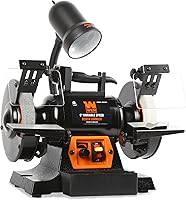
The DW758 combines 8-inch wheels, a 3/4 HP induction motor and wide wheel spacing for general shop grinding. It has a cast iron base and motor housing, precision-machined aluminum tool rests and rear exhaust ports in the wheel guards.
DeWalt DW758 8-Inch Bench Grinder: Best for larger grinding jobs

- 8-inch wheels
- 3/4 HP induction motor
- Fixed 3,600 rpm
- 12-1/2-inch wheel spacing
Choose the DW758 for general shop grinding and longer parts that need room between the wheels. Its fixed speed favors material removal over slower edge work.
Pros
- Wide spacing for longer workpieces
- Precision-machined aluminum tool rests
- Cast iron base and motor housing
- Includes 36-grit and 60-grit wheels
Cons
- No speed adjustment
- Fast grinding calls for care around thin cutting edges
The included 36-grit and 60-grit wheels give you a coarse option for removing material and a finer option for refining the shape. Neither should be treated as a complete sharpening system for every cutting tool.
Eye shields, spark deflectors and tool rests are included. Those parts need correct adjustment before use, and the shields don't replace personal eye protection.
Where the DeWalt DW758's wheel spacing helps
The 12-1/2-inch distance between wheels is useful when a longer part would otherwise crowd the opposite wheel. Think about the path of the whole workpiece, including handles, bends and sections extending behind the area being ground.
Spacing alone doesn't settle fit. A broad or curved part can still meet the motor housing or guard, so check its working position before committing to this grinder.
Who should choose the DW758, and who should skip it?
Choose the DW758 if your regular jobs involve deburring steel, reshaping blunt ends or removing unwanted metal. It fits a garage or shop where grinding is a frequent maintenance task and there is room for a permanent station.
Examples include cleaning up a rough steel edge or reshaping a damaged screwdriver tip. Use a wheel approved for the material, and remove only enough metal to restore the intended shape.
Skip it as your first choice if most sessions involve taking a tiny amount off a chisel or plane iron. A slower grinder gives you more time to judge each pass, though wheel choice and pressure still control the result.
Also skip it if you need a finished cutting edge straight from the machine. Many woodworking tools need honing after grinding, regardless of which grinder forms the bevel.
For mixed repair work, compare the WEN BG625V variable-speed grinder. If edge maintenance dominates your work, the BUCKTOOL low-speed grinder is the more focused alternative.
What are the DW758's main trade-offs?
The main trade-off is fast, fixed speed without a slower setting. That suits stock removal, but thin edges demand brief contact and frequent checks because grinding friction creates heat.
More pressure isn't the answer to a wheel that cuts poorly. Forcing the work can increase heat, spoil the shape and make the part harder to control.
The machine measures 17.75 x 12.63 x 11.73 inches. Treat that as the space occupied by the grinder, then add working clearance for your hands, the workpiece and access for maintenance.
Its larger wheels also change the bevel shape. An 8-inch wheel generally leaves a shallower hollow grind than a smaller wheel, but that matters mainly when you deliberately grind a bevel to prepare for honing.
Don't choose by horsepower alone. A higher motor figure won't correct poor support, a glazed abrasive surface or a wheel that doesn't suit the material.
How does the DW758 compare with alternatives?
The DW758 favors larger work and material removal, while the alternatives favor adjustable speed, sharpening-station features or slower operation. Start with the task you repeat most often, then compare the supporting features.
| Grinder | Motor | Speed | Wheel size | Main reason to choose it |
|---|---|---|---|---|
| DeWalt DW758 8-Inch Bench Grinder | 3/4 HP | 3,600 rpm | 8 in | Wider spacing for longer parts |
| WEN BG625V 6-Inch Variable Speed Grinder | 2.5 amp | 2,000 to 3,400 rpm | 6 in | Speed adjustment for mixed jobs |
| JET 8-Inch Bench Grinder | 1/2 HP | 3,450 rpm | 8 in | Lights and a coolant tray |
| BUCKTOOL 6-Inch Bench Grinder | 1/3 HP | 1,750 rpm | 6 in | Slower edge maintenance |
WEN BG625V: adjustable speed for mixed maintenance
The WEN BG625V suits buyers who switch between deburring and edge work. You can change speed to suit the task instead of using one fixed setting for everything.
WEN BG625V 6-Inch Variable Speed Grinder: Best for mixed maintenance tasks

- 6-inch wheels
- 2.5-amp motor
- 2,000 to 3,400 rpm
- Flexible work light
The WEN suits a home shop that alternates between deburring and edge maintenance. Adjustable speed, a flexible light and pivoting rests help you set up for different jobs.
Pros
- Adjustable speed
- Flexible work light
- Includes coarse and finer wheels
- WEN backs it with a two-year warranty
Cons
- Smaller wheels than the DW758
- Lowest speed remains above the BUCKTOOL's fixed speed
It includes a flexible work light, pivoting tool rests and 36-grit and 80-grit wheels. WEN backs it with a two-year warranty.
Choose it for smaller parts and varied maintenance jobs where seeing the contact point and changing the setup matter. Its pivoting rests are useful when you need to support a part at an angle.
Skip it if your main reason for considering the DW758 is clearance for larger workpieces. Also, its lowest setting is still above the BUCKTOOL's speed, so adjustable doesn't mean equally slow.
JET JWBG-8HS: a dedicated sharpening station
The JET JWBG-8HS suits buyers who want lighting and a coolant tray built into their grinding station. Those features keep common sharpening aids close to the work.
JET 8-Inch Bench Grinder: Best for dedicated sharpening stations

- 8-inch wheels
- 1/2 HP motor
- 3,450 rpm
- LED lights and coolant tray
The JET suits a fixed sharpening station where wheel lighting and a nearby coolant tray are useful. It remains a high-speed grinder, so light passes still matter.
Pros
- Built-in coolant tray
- Battery-powered LED work lights
- Adjustable work rests
- JET backs it with a five-year warranty
Cons
- No speed adjustment
- Mounting bolts and nuts are not included
Battery-powered LED lights illuminate both wheels, with batteries included. The grinder also has adjustable work rests and comes with 36-grit and 60-grit aluminum oxide wheels.
Choose it if you want a fixed station for tool maintenance and will use the tray during suitable sharpening work. JET backs it with a five-year warranty, but bench-mounting bolts and nuts must be obtained separately.
Skip it if your goal is low-speed grinding. Its tray doesn't cool the wheel automatically, and you still need light passes; JET also states that this grinder isn't intended for aluminum or magnesium.
BUCKTOOL: slower work near a cutting edge
The BUCKTOOL suits buyers who mainly maintain tool edges and prefer a slower pace. Its fixed low speed makes it a more direct fit for that routine than a grinder chosen for rapid removal.
BUCKTOOL 6-Inch Bench Grinder: Best for careful edge maintenance

- 6-inch wheels
- 1/3 HP motor
- Fixed 1,750 rpm
- 60-grit and 80-grit wheels
Choose the BUCKTOOL when controlled edge work matters more than rapid stock removal. Its slower fixed speed suits a sharpening-focused bench.
Pros
- Slower wheel speed
- Includes brown and white aluminum oxide wheels
- Tool-free adjustable work rests
- BUCKTOOL backs it with a two-year limited warranty
Cons
- No variable-speed control
- Less suited to buyers prioritizing rapid stock removal
It includes a 60-grit brown aluminum oxide wheel, an 80-grit white aluminum oxide wheel and tool-free adjustable rests. The cast aluminum base has rubber feet, and BUCKTOOL backs it with a two-year limited warranty.
Choose it for careful shaping where you want to check progress often. A slower wheel still generates heat, so don't use speed as a reason to hold an edge against it continuously.
Skip it if heavy reshaping is the main job. Its smaller wheels and lower motor power suit a different workload from the DeWalt.
How should you choose wheels for your work?
Choose wheels by material, task and full fit requirements, rather than diameter alone. A wheel must match the grinder's approved dimensions and have a maximum operating speed suitable for the machine.
Check the manual for bore size, thickness, flange requirements and permitted wheel types. Don't assume that an accessory fits safely because it can slide onto the shaft.
A coarse abrasive is useful for changing a shape or removing a damaged section. Move to a finer abrasive when you need to refine that shape, while remembering that grit number alone doesn't determine the finish.
For ordinary peripheral grinding wheels, work on the intended grinding face. Don't grind on a wheel's side unless that wheel and the grinder instructions explicitly allow it.
Material compatibility matters just as much. Don't grind soft metals on an ordinary wheel meant for steel; unsuitable material can load the abrasive and create hazards.
What should you check before installing the DW758?
Set up the DW758 on a rigid mounting surface with clear space for sparks and workpieces. A bench that flexes or rocks needs attention before the grinder goes into service.
Plan the work position with the power disconnected. You should be able to support the part without reaching across a wheel, twisting your wrists or crowding the guards.
Secure the grinder as DeWalt directs, then install and adjust its rests, shields and spark deflectors. Follow the manual's clearances, since gaps need attention as the abrasive wheels wear.
Keep wood shavings, solvent containers and other combustible materials away from the spark path. Don't route grinding sparks into a dust system intended for wood waste.
Lighting should make the contact point easy to see without forcing you closer to the wheel. Keep the switch accessible and route the cord away from hot debris and foot traffic.
The bench grinder safety guide covers protection and basic operating habits. For bench placement alongside other machines, use the small woodworking shop setup guide.
How do you grind without ruining an edge?
Use light, brief passes with the work supported on the rest. Start with a clear idea of the shape you want, then stop often enough to check progress before removing too much.
Allow the wheel to reach operating speed before contact. Hold the part securely and move it across the usable wheel face rather than wearing a groove in one spot.
Watch the edge and its angle, not just the stream of sparks. A marked bevel can help show where material is being removed during early passes.
Thin sections heat quickly. Pause frequently and follow the tool steel's cooling guidance; don't wait for visible discoloration to tell you that you've held contact too long.
For a chisel or plane iron, grinding usually prepares the bevel for honing. Keep that finishing step in your plan instead of chasing a polished edge with a coarse wheel.
Very small parts can be difficult to hold safely at a bench grinder. If a part can't be supported and controlled, use another suitable method rather than bringing your fingertips close to the wheel.
A file can be a better choice for a small correction. Our best bench vises guide can help you choose workholding for filing and other bench repairs.
What care does a bench grinder need?
Keep the wheels clean, correctly shaped and properly supported. A clogged or uneven abrasive surface can cut poorly and tempt you to apply more pressure.
Inspect wheels for damage before use and follow the manual's inspection procedure when installing replacements. If a wheel is chipped, cracked or otherwise suspect, stop using it.
Dress a wheel with a compatible dresser when its surface becomes glazed, loaded or uneven. Follow the dresser's instructions, remove only what is needed and readjust the rests afterward.
Disconnect power before maintenance or adjustments. Clear accumulated debris with a suitable brush or vacuum after the machine has stopped and hot particles have cooled.
If vibration appears, stop and find the cause. Check mounting, wheel condition and correct assembly rather than assuming vibration is normal or tightening parts harder.
Store replacement wheels where they won't be dropped or struck. Avoid piling tools against exposed wheel edges, even when the grinder is unplugged.
Which common buying mistakes should you avoid?
Avoid buying for maximum power when your real need is control. A grinder used mainly for sharpening should be chosen around the edge work, not the biggest motor figure.
Don't treat a coolant tray or work light as a substitute for the right speed and technique. Convenience features help the routine, but they don't prevent excess material removal.
Don't spend the entire equipment budget on the machine. Plan for suitable eye and face protection, correct mounting hardware, a compatible dresser and any task-specific support you need.
Finally, check the replacement-wheel requirements before buying accessories. A useful grinder needs compatible abrasives for your jobs, not just the pair that comes in the box.
Is the DeWalt DW758 the right choice for your shop?
Choose the DeWalt DW758 for larger steel work and regular stock removal. Make the decision around the parts you actually handle and whether they fit safely at the rests.
Choose the WEN when varied maintenance calls for speed adjustment, the JET when a fixed sharpening station would benefit from lights and a tray, or the BUCKTOOL when slower edge work dominates.
For more options, use our best bench grinders guide to compare machines around your main task. The grinders and vises category also covers related tools for holding and shaping shop parts.
Frequently asked questions
Is the DeWalt DW758 a good bench grinder?
The DeWalt DW758 is a good fit for general shop grinding, especially larger steel parts and jobs that need substantial material removal; its wide wheel spacing helps with longer pieces. Choose a slower grinder if your main work is maintaining thin cutting edges rather than reshaping metal.
What size wheels does the DeWalt DW758 use?
The DW758 uses 8-inch wheels and comes with 36-grit and 60-grit wheels. Diameter alone isn't enough when choosing replacements: match the bore, thickness, wheel type and speed requirements in DeWalt's manual; use an abrasive approved for the workpiece material and the way you plan to grind.
Does the DeWalt DW758 have variable speed?
No, the DW758 runs at a fixed 3,600 rpm; the WEN BG625V offers adjustable speed from 2,000 to 3,400 rpm, while the BUCKTOOL runs at a fixed 1,750 rpm. Choose the WEN for adjustment across tasks or the BUCKTOOL when slower edge work is your main priority.
How far apart are the DW758 grinder wheels?
The DW758 has 12-1/2 inches between its wheels, which gives longer workpieces more room across the grinder; that gap doesn't guarantee clearance for every shape. Check where the motor housing, guards and tool rests will sit relative to your part, and allow room to move it safely.