DeWalt DW734 Planer Review: Worth It? (November 2026)
The DeWalt DW734 is the planer to buy for everyday board surfacing in a small shop. Its three-knife cutter head and four-column carriage lock give you a clean finish and less snipe without a big footprint.
On this page (7 sections)
The DeWalt DW734 is the benchtop planer to buy for everyday board surfacing, especially when you want a clean finish and fewer snipe problems in a shop without room for a floor model. Its 12.5-inch cutting width handles most cabinet and furniture stock, and the three-knife head does the finishing work for you.
If you regularly feed wide glued-up panels or need extra motor headroom for deep cuts in dense hardwood, look at the bigger DW735 instead. For most small shops working boards down to thickness, the DW734 is the simpler, lighter answer.
The DeWalt DW734 at a glance
The DW734 puts a 15 amp motor and a three-knife cutter head on a benchtop frame. DeWalt says the head spins at 10,000 rpm and makes 96 cuts per inch, one of the finest finishes it claims for a portable planer.
The four-column carriage lock is the feature that matters most for day-to-day results, because it holds the head steady and cuts down on the dip at the start and end of a pass.
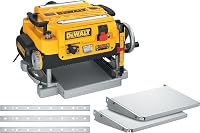
DeWalt DW734 12.5-Inch Benchtop Planer: Best for everyday board surfacing

- 15 amp motor
- 12.5-inch cutting width
- Three-knife cutter head
- Four-column carriage lock
- 33-1/2 inches of table support
A benchtop planer built around a three-knife head and a four-column carriage lock. It turns rough boards into flat, even stock without taking over the bench.
Pros
- Three-knife head gives 96 cuts per inch
- Four-column carriage lock reduces snipe
- Reversible knives last 30% longer per DeWalt
- Long feed tables add 33-1/2 inches of support
- Turret depth stop saves repeat settings
Cons
- 12.5 inches is under the 13-inch width of a full-size benchtop
- Heavy at 80 lb, so it wants a permanent spot
- No built-in dust collection beyond the included hood
It's a planer you set up and leave in place. At about 80 lb and roughly 23 by 16 by 20 inches, it fits on a sturdy bench but doesn't want to be lifted onto a shelf after each session.
Build or buy a cart if you need to move it around the shop.
The base is metal, which gives the cutter head a stable frame to work against and helps the four-column lock do its job. The machine is sold as a single unit with the dust hood as the only included component, so plan for a shop vac or dust collector before the first board goes through.
Black and yellow is the usual DeWalt color scheme, but the part that matters is the cast frame under it.
Who should buy the DW734
Buy it if you build furniture, cabinets or trim and need consistent thickness from rough or reclaimed boards. It suits a home shop or a small professional bench where 12.5 inches of width covers most of the stock you run.
It also fits anyone who wants to skip the sanding stage that a rougher cut forces on them. The three-knife head leaves a surface that is close to finish-ready, so you spend less time with a random orbital sander and more time on joinery.
That matters if you build in batches and every saved minute adds up over a project.
Skip it if you routinely surface slabs or panels wider than 12.5 inches. That's a real limit, not a small inconvenience, because a board that won't fit has to be flattened another way.
A 13-inch planer gives you a little more room at the edges.
The specs that matter in daily use
The three-knife cutter head and the four-column carriage lock are the two specs that decide how the DW734 feels in your shop. A three-knife head makes more cuts per revolution than a two-knife head, so the surface comes off cleaner and needs less sanding.
DeWalt also says the disposable knives are reversible and deliver 30% more knife life, which spreads the cost of replacements over more board feet.
The 15 amp motor is what lets you take a deeper pass without bogging down. In hardwood especially, a stronger motor means fewer light passes and less time running the same board through twice.
The 20,000 rpm motor speed and 10,000 rpm cutter-head speed are the numbers behind that 96 cuts-per-inch figure. The cutter head runs at half the motor speed, which is how the gearing trades raw rpm for torque at the knives.
The four-column carriage lock holds the cutter head square and steady. Snipe comes from head movement at the board's leading and trailing edges, so locking the carriage after you set depth is the practical habit that gets the most from this design.
Four columns rather than two spread the clamping force across the head, so it resists rocking as the board passes under it. Pair it with the 33-1/2 inches of infeed and outfeed table support and long boards stay level as they pass under the head.
The material removal gauge and extra-large thickness scale help you set depth accurately. The turret depth stop is a quieter but useful extra: set your most common thicknesses once and snap back to them instead of measuring each time.
If you build the same cabinet sides or drawer parts repeatedly, that saves real minutes over a week.
The cutting depth tops out at 0.13 inches per pass. That's a useful figure to keep in mind, because it tells you how much stock you can take off in one trip and how many passes a rough board will need before it cleans up.
One practical note: the DW734 takes boards up to 12.5 inches wide, so measure your widest stock before you commit. Check the exact dimensions on the product page if bench space is tight.
Setting up the DW734 for clean boards
Start by giving the planer a level, sturdy surface and enough room for long boards to travel. The infeed and outfeed tables extend the bed to 33-1/2 inches, so a full 8-foot board needs clear space on both sides.
A cart or mobile base keeps it at a comfortable working height without lifting it each session.
Mount the dust hood that comes in the box and connect a shop vac or dust collector. Planing makes a lot of chips, and the hood directs them away from the cutter head so they don't get pressed back into the surface.
Check the hose run so it doesn't pull the hood loose as you feed boards.
Set the depth with the material removal gauge, then lock the four-column carriage. Feed boards with the grain and keep steady pressure on the infeed and outfeed tables so the board doesn't rock as it enters and exits.
Run both faces if you need parallel surfaces, and take light passes rather than trying to remove too much at once.
The turret depth stop rewards a little setup time. Dial in the thicknesses you use most, mark them, and you can return to them without re-measuring.
That matters when you're running a batch of identical parts and want every one to come out the same.
Check your first board with calipers after each pass. The thickness scale gets you close, but a quick measurement tells you whether you need one more light pass or whether you've reached your target.
Keep a short offcut of the same stock nearby as a test piece so you don't risk a good board while you dial in the depth stop.
Care and knife changes
The DW734 stays accurate with regular cleaning and prompt knife changes. Brush chips off the feed rollers and table between sessions, because packed chips change how the board tracks and can leave marks on the surface.
Pay attention to the four columns as well, since chips there can throw off the carriage lock over time.
The disposable knives are reversible, so when the finish starts to tear or the motor works harder on a light pass, flip them before replacing them. DeWalt says the change is fast and easy, and the reversible design doubles the usable life of each set before you buy new ones.
Keep a spare set on hand so a dull knife doesn't stop a project.
Wax or lightly lubricate the table as DeWalt allows so boards slide smoothly. Check the four-column carriage for chips and keep the columns clean so the lock stays effective.
A little maintenance here is what keeps the snipe control working over years of use.
Store the planer covered if your shop is dusty or damp. Blow out the motor vents occasionally and check the cord for damage.
The three-year limited warranty covers defects in materials and workmanship, but it doesn't cover normal wear or abuse, so keep your receipt and model number. Accessories are not covered either, so treat the dust hood as something to look after rather than a warranty item.
Common setup mistakes to avoid
The most common mistake is setting depth with the carriage unprotected. The lock is there to hold the head steady during the cut, and leaving it loose gives back some of the snipe control the design is built around.
Lock it after every depth change.
The second is feeding a long board without support on both sides. The tables are what keep a board level as it enters and leaves the head, so a board that sags at the infeed or outfeed will dip at the ends no matter how well the head is locked.
Set up the tables before you run the first board, not after you notice snipe.
The trade-offs to know before you buy
The 12.5-inch width is the main limit, since it falls just short of the 13 inches some benchtop planers offer. If your projects regularly include wide panels, that half inch matters more than the spec sheet suggests.
Measure your widest stock and decide whether 12.5 inches covers it.
The second trade-off is weight. At about 80 lb the DW734 is heavy enough that moving it between benches or in and out of storage gets old fast.
Plan a permanent spot with room for the feed tables, or put it on a mobile base you can roll into position.
The third is dust collection. The DW734 includes a dust hood, but you'll still need a shop vac or collector to keep chips under control.
Planing without extraction fills the shop with chips and can leave them pressed into the surface.
The fourth is the depth of cut. At 0.13 inches per pass you take a modest bite each time, so a rough board that needs a lot of material removed takes several passes.
That's normal for a benchtop planer and it protects the finish, but it is time to budget for when you're milling a stack of boards.
Those points aside, the DW734 keeps its settings well and produces a clean finish for its class. If you want more motor and a wider cut, the next size up in DeWalt's range costs more and takes more bench space.
For many small shops the trade-off is worth it either way.
How the DW734 compares to the alternatives
The DW734 sits in the middle of DeWalt's benchtop range, and the choice mostly comes down to width, motor size and how much you want to spend. These three options cover the realistic alternatives.
DeWalt DW735
The DW735 is the step up in DeWalt's line, with more capacity for wide stock and heavier cuts. If your work leans toward large panels or dense hardwood, the extra headroom earns its place.
Our DeWalt DW735X review covers the version with the extended infeed and outfeed tables and the mobile base.
WEN PL1326
The WEN PL1326 is the budget-friendly alternative for a shop that wants a wider cut without DeWalt's price tier. It's a reasonable first planer for hobby work.
Our comparison of the WEN PL1326 vs DeWalt DW735 walks through the differences.
Head to head
If you're torn between the two DeWalt models, the DW734 vs DW735 comparison spells out which one fits a small bench and which one suits a bigger shop. Start there before you decide.
The short version: the DW734 is the smaller-footprint machine with the three-knife head and four-column lock, while the DW735 trades bench space for more capacity and motor headroom.
Verdict: who should buy the DeWalt DW734?
Buy the DW734 if you surface boards up to 12.5 inches wide and want a clean finish without a big machine. Its three-knife cutter head, four-column carriage lock and 33-1/2 inches of table support handle everyday cabinet and furniture stock well.
The turret depth stop and material removal gauge make repeat work easier, and the reversible knives keep running costs reasonable.
The metal base and 15 amp motor give it the weight and power to stay steady on a benchtop.
Skip it if you regularly need more than 12.5 inches of width or want the extra motor headroom of the DW735. Those shoppers should read the thickness planer buying guide and compare wider models first.
For most home shops working typical boards, though, the DW734 is the planer to put on the bench and leave there.
Frequently asked questions
Is the DeWalt DW734 a good planer for a small shop?
Yes. It's a benchtop model that covers 12.5 inches of width, so it handles most furniture and trim boards without the space a floor-standing planer needs.
At about 80 lb it stays put, so plan a dedicated spot rather than moving it between jobs.
What is the DW734's cutting width?
The DW734 takes boards up to 12.5 inches wide. That covers most cabinet and furniture stock, though wide slabs or glued-up panels over 12.5 inches need a wider planer or a sled-based workaround.
How does the four-column carriage lock help?
The four-column carriage lock clamps the cutter head to reduce the movement that causes snipe, the shallow dip at the start and end of a board. Lock the carriage after setting your depth, and feed boards through with steady support from the long infeed and outfeed tables.
Are the DW734 knives reversible?
Yes. The DW734 uses disposable, reversible knives.
DeWalt says they give 30% more knife life and that changing them is fast.
Flip or replace them when the finish starts to tear or the motor works harder on light passes.
How much space does the DW734 need?
The planer measures about 23.4 inches long, 16.5 inches wide and 20.5 inches tall. Add room for the 33-1/2 inches of infeed and outfeed table support plus clearance for boards going through, so a full 8-foot board can travel without hitting a wall.
Does the DeWalt DW734 come with a warranty?
DeWalt backs the DW734 with a three-year limited warranty. It covers defects in materials and workmanship and excludes normal wear, abuse and damage from repairs made by others.
Keep your receipt and model number in case you need service.