How to Choose Bench Grinders for Sharpening Lathe Tools
The best bench grinder for sharpening lathe tools is a slow-speed 8-inch model with two grits and adjustable tool rests, because low RPM keeps heat out of the cutting edge. Pick a 1,750 RPM 8-inch grinder first, and step down to a 6-inch single-speed only for light touch-ups.
On this page (10 sections)
- Why wheel speed matters most for lathe tools?
- Which wheel size should you choose?
- What grits do you need for shaping and honing?
- Why the tool rest decides your bevel angle?
- Does an 8-inch low-speed grinder beat a 6-inch high-speed model?
- Should you add a sharpening jig to your setup?
- What should you check before you buy?
- How do you set up a grinder for clean bevels?
- How do you keep the edge cool while grinding?
- Which grinder should you buy for lathe tools?
The best bench grinder for sharpening lathe tools is a slow-speed 8-inch model with two grits and adjustable tool rests. Low RPM is the feature that matters most, because it keeps heat out of the cutting edge while you shape a bevel.
Most buyers start with wheel speed and wheel size, then work out grits, rests and safety guards. Those four choices decide whether a grinder sharpens a clean bevel or burns the steel blue.
This guide walks through each decision in order and names the grinder we would buy first. For a wider field of machines, browse our roundup of the best bench grinders.
Why wheel speed matters most for lathe tools?
Slow speed is the top priority for lathe tools because heat ruins a cutting edge faster than a coarse wheel does. A wheel that turns at 1,750 RPM gives you more seconds of contact before the steel overheats.
Lathe tools are usually high-speed steel. That steel loses its temper when the edge gets too hot, and a blued tip will not hold an edge for long.
Speed control is how you avoid that.
The RIKON 80-805 runs its 1/2 HP motor at 1,750 RPM. RIKON says the slow speed helps reduce heat buildup and gives controlled grinding.
That is the spec to look for.
A single-speed grinder at 3,450 RPM removes metal faster, which suits rough reshaping but punishes a light touch. Beginners especially benefit from the slower wheel.
Pick a slow-speed grinder first if you sharpen often or work with expensive gouges. A high-speed machine only makes sense when most of your work is heavy reshaping on cheap tools.
Before you plug anything in, read our guide on how to use a bench grinder safely, since a spinning wheel with a loose rest is the real risk.
Which wheel size should you choose?
Choose an 8-inch wheel for most lathe work and a 6-inch wheel only for light touch-ups or a tight budget. Wheel size changes the bevel curve and the amount of control you get.
An 8-inch wheel presents a flatter arc to the tool, so a bevel comes out straighter and easier to repeat. The larger circumference also moves more steel past the rest per turn.
A 6-inch wheel curves more sharply. That hollow grind can suit some gouges, but it takes more care to keep an even bevel across the full edge.
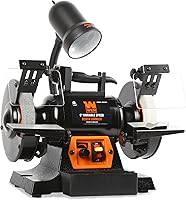
The WEN BG4260 uses 6-by-3/4-inch wheels and spins them up to 3,450 RPM. That combination is fine for reviving old tools, knives and bits, and it is light enough to move around.
Pick 8 inches for a main sharpening station and a 6-inch machine as a second grinder or a starter unit. If bench space is tight, the smaller cabinet wins on footprint alone.
Wheel width matters too. Wider wheels give a broader contact patch, but most lathe work sits comfortably within a 1-inch face.
The WEN BG4260 spins 6-by-3/4-inch wheels, while the RIKON 80-805 uses 8-inch by 1-inch wheels. That extra inch of face on the RIKON gives you a little more room to sweep a wide gouge across the wheel without running off the edge.
The WEN's wheel guard comes off simply, which matters when you change wheels.
What grits do you need for shaping and honing?
You need at least two grits: a coarse wheel for reshaping and a finer wheel for the final edge. Swapping wheels on one arbor is slower than having both mounted.
A 60-grit wheel takes material off quickly when you need to repair a nick or reset a bevel. A 120-grit wheel refines that bevel and leaves a cleaner edge for the final cut.
The RIKON 80-805 ships with 8-inch 60- and 120-grit wheels on a 5/8-inch arbor. That pair covers rough grinding, shaping and finer sharpening without a wheel change.
The WEN BG4260 includes a 60-grit wheel and a 36-grit wheel with 1/2-inch arbors. The 36-grit is coarse for fast material removal, which suits reshaping but is rough for a finished edge.
Plan the coarse wheel on one side and the finer wheel on the other. That layout lets you shape and hone in one session instead of stopping to swap wheels.
Dressing the wheels keeps the grit cutting cleanly. The RIKON kit includes a diamond wheel dresser for that job, so the face stays flat as you work.
Should you swap wheels or keep two mounted?
Two mounted wheels save time, but the grits you keep matter more than the count. A 60-grit and a 120-grit pair is the sweet spot for lathe tools.
The WEN's 36-grit and 60-grit pair leans toward removal speed. That suits reviving old tools and resetting a badly worn bevel, but the 60-grit becomes your fine wheel.
On the RIKON, the 120-grit wheel does the finishing work. That is the difference between a grinder built for sharpening and one built for general grinding.
Decide by what you sharpen most, not by the grits in the box. If you touch up edges often, the finer pair on the RIKON is the better start.
Why the tool rest decides your bevel angle?
The tool rest is the part that controls your bevel angle, so a weak rest makes every sharpening pass a guess. Adjustable rests that lock firmly are worth more than extra motor power.
A rest holds the tool at a fixed angle against the wheel. If it flexes or drifts, the bevel changes from pass to pass and the edge comes out uneven.
The RIKON 80-805 has dual adjustable tool rests, and the left rest includes a groove for sharpening drill bits. That groove also helps steady a round tool shank.
The WEN BG4260 uses pivoting tool rests that let you set angled grinding positions. That adjustability helps, though a basic rest still relies on your hand to hold the angle steady.
For repeatable work, a dedicated jig is the upgrade. The VEVOR Bench Grinder Tool Rest fits most 6-inch and 8-inch bench grinders and holds blades and chisels up to 2.5 inches wide.
Set the rest close to the wheel and lock it, then check the gap before every session. A rest that sits too far back lets the tool dip into the wheel.
Does an 8-inch low-speed grinder beat a 6-inch high-speed model?
Yes, for lathe tools the 8-inch low-speed grinder is the better buy because control and heat matter more than removal speed. A 6-inch high-speed model is the better pick for light, occasional work.
The slow wheel gives you time to feel the bevel meet the stone. That feedback is how you learn to sharpen freehand without burning an edge.
The high-speed 6-inch machine removes steel faster and costs less bench space. It suits deburring, cleaning up old chisels and quick touch-ups on small tools.
If most of your turning is small spindle work and you sharpen rarely, the WEN BG4260 covers it. If you turn bowls and sharpen weekly, the slow 8-inch RIKON 80-805 is the one to buy.
The same logic shows up when people compare 8-inch machines directly. Our DeWalt DW758 review looks at another 8-inch grinder and how its specs stack up for sharpening duty.
Match the grinder to how often you sharpen, not to the biggest motor you can afford. A slow wheel you use every week beats a fast one you fight every time.
The WEN's 2.1-amp motor and 14-pound frame make it easy to lift onto a shelf between jobs. The RIKON weighs 37 pounds and measures 16.38 inches long, so it wants a permanent spot on a bench or stand.
That weight is part of why it stays put while you press a tool into the wheel.
Should you add a sharpening jig to your setup?
Add a jig if you want the same bevel angle every time without relying on steady hands. A jig locks the tool and slides it across the wheel face.
The VEVOR rest slides forward and backward and locks with an adjustment knob. Two ratchet handles set the height and rotate the platform from 0 to 90 degrees.
Its flat miter slide holds the blade and lets it move left and right. That keeps the edge square to the wheel as you sweep across the face.
The jig fits most 6-inch and 8-inch bench grinders, as well as sanders and angle grinders. It holds blades and chisels up to 2.5 inches wide.
Pick a jig for gouges and chisels you sharpen often. Freehand sharpening is fine for rough work and quick touch-ups, but the jig pays off when consistency matters.
How does the jig mount to a grinder?
The jig is a separate accessory, and the grinder is not included. It clamps onto the grinder so the miter slide sits at the wheel face.
The setup runs in four steps: mount the jig, adjust the angle, fix the blade and start sharpening. The adjustment knob locks the slide once you find the position.
The aluminum alloy body is light at 1.5 pounds and resists wear and corrosion. That matters little at the bench, but it makes the jig easy to move between machines.
The 0 to 90 degree tilt covers most bevels you would set on a lathe tool. Lock the angle, then check the bevel against the wheel before the first pass.
What should you check before you buy?
Before you buy, check speed, wheel size, arbor size and the rest design against the tools you actually sharpen. Those four specs decide how the grinder behaves at the wheel.
Start with the motor speed. A 1,750 RPM machine suits edge work, while a 3,450 RPM machine suits fast stock removal.
RIKON states 1,750 RPM for the 80-805; WEN states up to 3,450 RPM for the BG4260.
Check wheel size and arbor next. The RIKON uses 8-inch wheels on a 5/8-inch arbor; the WEN uses 6-inch wheels on a 1/2-inch arbor.
Replacement wheels must match both numbers.
Look at the base and feet as well. The RIKON 80-805 sits on a cast-iron base with anti-vibration rubber feet and mounting holes for a bench or stand.
A steady base keeps the bevel from wandering.
Confirm the safety kit. The RIKON includes adjustable eye shields and spark arrestors, and both machines carry a warranty: 5 years for RIKON and 2 years for WEN.
If you plan to mount the grinder beside other work, our guide to the best bench vise covers holding work steady at the same bench.
How do you set up a grinder for clean bevels?
Set up starts with a stable mount, a small rest gap and true wheels. Get those right and the grinder does most of the work for you.
Mount the grinder so the wheels sit at a comfortable height, roughly at your forearms. Bolt it down through the base holes, or clamp it firmly to a solid bench.
Set each tool rest close to the wheel face and lock it. Spin the wheel by hand first to check clearance before you switch on the motor.
Dress new wheels before the first sharpening pass. A diamond dresser flattens the face and exposes fresh grit, which cuts cooler and cleaner.
Adjust the eye shields and spark arrestors to suit your stance. The shields should sit between your eyes and the wheel, and the spark stream should point down and back.
Keep a water cup within reach and dip the tool often. Short passes with light pressure and frequent cooling protect the temper of the steel.
Both grinders run on 120 volts. The RIKON is rated at 745.7 watts and the WEN at 745 watts, so either one fits a standard shop outlet without a special circuit.
Check the cord reach against where your bench sits before you commit to a spot.
How do you keep the edge cool while grinding?
Keep the edge cool by using light pressure, short passes and frequent cooling, whatever the wheel speed. Heat control is a habit, not just a motor spec.
Touch the tool to the wheel for a second or two, then lift and check the bevel. Let the steel cool or dip it in water before the next pass.
Let a very hot edge cool a little before you dip it. A sudden plunge into cold water can crack the tip.
Keep the tool moving across the wheel face. Holding it in one spot builds heat fast and digs a groove into the wheel.
A slow-speed wheel gives you more margin for error, which is why the RIKON 80-805 is the pick for most turners. Its 1,750 RPM leaves time to react before the edge overheats.
What does a blued edge tell you?
A blue tint on the steel means the edge got hot enough to lose temper. That edge will dull fast no matter how carefully you grind the next time.
When you see blue, grind past the damaged section on the coarse wheel and re-sharpen the bevel. Then change your habits: shorter passes and more dips.
The spark stream tells you something too. Long, bright sparks mean heavy pressure and heat; a light touch gives a smaller, duller stream.
Stop when the edge turns blue. That color means the steel has lost temper, and you need to grind past the damaged section and re-sharpen the bevel.
Which grinder should you buy for lathe tools?
Buy the RIKON 80-805 Professional 8-Inch Low Speed Bench as your main sharpening grinder. It is the best bench grinder for sharpening lathe tools for most turners, with a slow 1,750 RPM motor and two grits mounted and ready.
Its 1/2 HP motor, 8-inch 60- and 120-grit wheels and dual adjustable rests cover shaping and honing in one station. The cast-iron base and rubber feet keep it steady, and the eye shields and spark arrestors are included.
Pick the WEN BG4260 6-inch single-speed grinder instead if you sharpen only now and then and want a compact unit. Its 36- and 60-grit wheels suit reshaping and quick touch-ups more than fine edge work.
Add the VEVOR Bench Grinder Tool Rest when you want repeatable bevels on gouges and chisels. It fits most 6-inch and 8-inch grinders and locks the angle so each touch-up matches the last.
The decision rule is simple: choose the slow 8-inch RIKON for regular lathe sharpening, the 6-inch WEN for light occasional work, and the VEVOR jig when consistency matters more than freehand speed.
Whichever you buy, mount it firmly, set the rests close and keep the steel cool. That routine is what makes any grinder the best bench grinder for sharpening lathe tools in your shop.
Frequently asked questions
What speed is best for sharpening lathe tools on a bench grinder?
A slow-speed grinder around 1,750 RPM gives you more control and less heat than a 3,450 RPM model. Heat is the main enemy of a sharp lathe edge, so the slower wheel is the safer default for most turners.
Do I need a jig to sharpen lathe tools on a grinder?
A jig helps when you want a repeatable bevel angle, especially for spindle and bowl gouges. Freehand sharpening works, but a sliding rest locks the angle so each touch-up matches the last.
Can I sharpen lathe tools on a 6-inch grinder?
Yes. A 6-inch grinder handles light touch-ups and small tools, though its smaller wheel curves more and runs at higher speed.
An 8-inch wheel gives a flatter bevel and more control for heavier reshaping.
What grit wheels should I use for lathe tools?
Use a coarse wheel for reshaping a damaged edge and a finer wheel for honing the final bevel. A 60-grit and a 120-grit pair covers rough grinding and finer sharpening without changing wheels.
How do I stop a bench grinder burning the tool edge?
Keep the tool moving, use light pressure and cool the edge in water often. A low-speed wheel, a steady tool rest and short passes all help keep the steel from turning blue.