Bench Grinder Buying Guide
Start with a 6-inch wheel if you sharpen tools, deburr metal or clean rusty parts in a home shop; step up to an 8-inch grinder only when you need longer wheel life and heavier stock removal. Match the speed, motor size and wheel grit to the work you do most, then choose the stand and rest setup around it.
On this page (10 sections)
- What size grinding wheel should you buy for a home shop?
- Which motor size and speed suit your grinding work?
- Which wheel grits do you need for sharpening and cleanup?
- How does speed affect sharpening and metal removal?
- What tool rests and guards make a grinder easier to use safely?
- Should you bolt your grinder to a bench or use a stand?
- Which bench grinder fits your shop?
- Which grinder fits sharpening lathe tools?
- What should you check before you buy a bench grinder?
- What's the bottom line on choosing a bench grinder?
A bench grinder buying guide starts with one decision: wheel size. A 6-inch grinder handles sharpening, deburring and light cleanup in a home shop.
An 8-inch machine suits heavier stock removal and longer wheel life, but it costs more and needs more room.
Speed, motor size and wheel grit matter next. So does where the grinder will sit.
This guide compares those choices against the work you actually do, from reviving dull chisels to cleaning up welds.
What size grinding wheel should you buy for a home shop?
A 6-inch wheel is the right size for most home shops. It covers sharpening, deburring and rust removal without taking much bench space.
Step up to 8 inches when the work is heavier or frequent.
Wheel size changes more than the footprint. It sets how much abrasive surface you have and how long a wheel lasts before it wears down.
A 6-inch wheel gives you about 18.8 inches of grinding circumference. That's enough to present a chisel, knife or mower blade at a steady angle without crowding the wheel face.
Smaller wheels are also cheaper to replace when they wear.
An 8-inch wheel gives you about 25 inches of circumference. The longer wheel life helps when you reshape thick steel or run a lot of tools across the wheel in a week.
The trade-off is a heavier machine, a bigger footprint and more expensive replacement wheels.
Match the wheel to your most common job. If you sharpen a few chisels and clean up small metal parts, a 6-inch grinder does the work.
If you repair equipment or grind a lot of thick stock, the 8-inch size earns its cost.
Check that the grinder's rated speed matches the wheel's maximum speed. A wheel rated lower than the spindle speed can come apart under load.
Which motor size and speed suit your grinding work?
A 2-amp to 3-amp motor on a 6-inch grinder covers home sharpening and deburring. Heavier motors and cast-iron housings matter when you grind thick stock for long stretches.
Motor size shows up in how quickly the grinder recovers when you press work into the wheel. For short passes on a chisel or a knife, a modest motor keeps the wheel spinning without bogging.
Speed is usually fixed on home grinders. A typical 6-inch model turns its wheels at about 3,450 RPM, which is fast enough for sharpening and general metal removal.
Faster spindle speeds suit hard steel; slower speeds give more control on soft or heat-sensitive metal.
A cast-iron base and motor housing add weight. That weight helps absorb vibration so the grinder stays put and the wheel runs smoother.
It also makes the machine harder to move around the shop.
If your work is occasional, a lighter 6-inch grinder is easier to lift onto a shelf between jobs. If the grinder will stay set up and you grind thick stock, the heavier build is worth the extra weight.
Single speed or variable speed?
Single speed is enough for most home shops. The wheels run at their rated speed and you control the cut with pressure and the rest angle.
Variable speed helps when you grind heat-sensitive steel or want finer control near the edge of a blade. You can slow the wheel to reduce heat buildup.
The cost is a higher price and an extra control to set before each job.
For a first bench grinder, choose single speed and put the savings toward a better rest or a stand. For a shop that sharpens many knives or tools in soft steel, variable speed is the more useful upgrade.
Which wheel grits do you need for sharpening and cleanup?
Plan on two wheels: a coarse wheel around 36 grit and a medium wheel around 60 grit. The coarse wheel removes metal fast, and the medium wheel refines the edge or cleans up the surface without gouging.
Grit describes how fine the abrasive particles are. A lower number means coarser particles and faster cutting.
A higher number means a smoother finish.
A 36-grit wheel is the workhorse for reshaping a damaged edge, knocking off weld spatter or removing heavy rust. A 60-grit wheel is the general-purpose choice for sharpening a chisel or knife to a clean edge.
Many 6-inch grinders ship with both wheels already mounted, one on each end. That lets you rough out a shape on the coarse side and move to the finer wheel without stopping to change anything.
If you sharpen woodturning tools or fine knives, a finer wheel or a slow-speed wet grinder gives a better edge. For general shop work, the standard 36 and 60 pair covers most tasks.
Wheel width and arbor size
Wheel width is measured across the face of the stone. A 3/4-inch-wide wheel gives you a narrow contact patch for controlled sharpening.
Wider wheels give more surface for deburring flat parts but need more motor torque.
Arbor size is the hole in the center of the wheel. Common sizes are 1/2 inch, 5/8 inch and 1 inch.
Check that replacement wheels match your grinder's arbor, or use the bushings that come with the wheel to adapt it. Match both diameter and arbor when you buy replacements.
How does speed affect sharpening and metal removal?
Higher spindle speed removes metal faster but builds heat quicker. Lower speed gives more control and less risk of burning a thin edge.
Match the speed to the steel you grind and the edge you want.
At about 3,450 RPM, a 6-inch wheel moves quickly enough to sharpen a dull chisel in a few light passes. The same speed can overheat a thin knife blade if you hold it against the wheel too long.
Heat changes the temper of hardened steel. Once a blade gets too hot, the edge softens and won't hold a sharp edge.
Light passes and quenching in water keep the tip cool, whatever the spindle speed.
For general shop tools like chisels, plane irons and mower blades, standard speed is fine as long as you work in short touches. For carving tools or thin knives, a slower wheel or a variable-speed grinder gives more margin.
Speed also affects how the wheel wears. Faster speeds wear wheels quicker and throw more sparks.
Slower speeds extend wheel life but take longer per pass.
Matching speed to the material
Hard carbon steel tolerates a faster wheel and benefits from quick material removal. Soft steel and thin blades need a lighter touch and more frequent cooling.
Cast iron and thick steel are where the extra speed and motor power of an 8-inch grinder help. For thin sheet metal, the wheel can catch and deform the edge, so slower speed and light pressure are safer.
What tool rests and guards make a grinder easier to use safely?
Adjustable tool rests, eye guards and spark deflectors turn a bench grinder into a controlled tool. A solid rest holds the work at a steady angle.
Guards and deflectors keep sparks and debris away from your hands and face.
The tool rest is the shelf in front of the wheel where you steady the work. A pivoting rest lets you tilt the shelf to match the angle of a chisel or a knife bevel.
That makes repeated passes more consistent than holding the work freehand.
Eye guards are clear shields that sit over the wheel. They block sparks and small fragments that the wheel throws.
Adjustable guards let you set them close to the wheel as it wears.
Spark deflectors sit at the top of the wheel guard and direct sparks down and away. Both guards and deflectors should be set close to the wheel without touching it.
A grinder with weak or missing rests is harder to use safely. Check that the rest locks firmly and that the guards adjust without tools, so you actually keep them set as the wheel wears.
Setting up the rest and guards
Set the tool rest close to the wheel, about 1/8 inch away. A smaller gap reduces the chance of work catching between the rest and the wheel.
Adjust the rest angle so the bevel of your tool sits flat on it.
Set the spark deflector and eye guard to match the wheel as it wears. Recheck both after you dress the wheel or fit a new one.
Keep the guards in place even for quick jobs, because removing them to get more clearance is the most common shortcut and the one most likely to cause an injury.
Should you bolt your grinder to a bench or use a stand?
Bolt a grinder to a solid bench when you have the space. Use a dedicated stand when bench space is tight or you want the grinder at standing height away from your main work surface.
A bench grinder vibrates. Bolting it to a sturdy bench holds it steady and keeps the wheel running true.
A bench that flexes under the vibration makes the grinder chatter and the edge harder to control.
A dedicated stand gives the grinder its own footprint. It puts the wheels at a comfortable height so you can stand and see the edge without bending.
It also keeps the vibration away from the bench where you do other work.
A stand with a water pot adds a place to quench hot work without walking across the shop. That makes light passes and cooling easier to manage when you sharpen a long blade.
Weight matters either way. A heavier stand or bench absorbs more vibration.
If the stand feels light or walks across the floor, bolt it down or add weight at the base.
Bench space and working height
Measure the height of your bench and how you stand at it. A grinder mounted too low makes you hunch, and one mounted too high puts the wheel above your line of sight.
A stand at about 31 inches puts the wheels near waist height for many people. Pick the setup that lets you see the wheel edge and keep your arms relaxed.
Which bench grinder fits your shop?
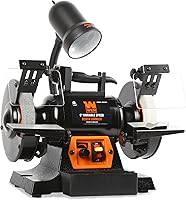
The WEN BG4260 is the best pick for most home shops. It pairs a 6-inch wheel with a 2.1-amp motor and ships with both a 36-grit and a 60-grit wheel.
The DEWALT DW756 is the heavier alternative for cast-iron durability and longer grinding sessions.
The WEN BG4260 turns its 6-by-3/4-inch wheels at up to 3,450 RPM. The 2.1-amp motor suits short passes on chisels, knives and bits.
It includes one 60-grit and one 36-grit wheel with 1/2-inch arbors, so you can rough and refine without changing wheels. WEN backs it with a two-year warranty.
The pivoting tool rests let you set an angle for sharpening. Adjustable eye guards block sparks.
The 14-pound build is light enough to lift onto a shelf, though that also means less mass to absorb vibration than a heavier grinder. Pick the WEN if you sharpen tools and clean up metal parts now and then.
The DEWALT DW756 steps up the motor to a 5/8 HP induction motor rated for heavy-duty grinding. Its cast iron base and motor housing add weight and durability.
The 12-1/2-inch distance between wheels gives more clearance for longer work. It runs at 3,450 RPM for high-speed material removal, and precision-machined aluminum tool rests let you position work accurately.
The DW756 weighs about 30 pounds, so it's best kept in one place. Pick it if you grind thick stock often or want a grinder that stays put and takes heavier use.
For a closer look, read our DeWalt DW758 review on the 8-inch model.
Which grinder fits sharpening lathe tools?
A 6-inch grinder with a fine wheel and an adjustable rest is the practical choice for sharpening lathe tools. The rest sets the bevel angle, and the finer wheel leaves a cleaner edge without heavy stock removal.
Lathe tools need a consistent bevel and a cool edge. A grinder with pivoting rests lets you set the rest to the bevel angle and slide the tool across the wheel.
The 60-grit wheel does most of the sharpening, while the 36-grit wheel only reshapes a damaged edge. Keep passes light and quench often so the steel stays cool.
For finer work or delicate gouges, a slow-speed grinder or a dedicated sharpening system gives more control. A standard 6-inch grinder still handles the basic bevel on most lathe tools when you use light passes.
Our guide to the best bench grinders for sharpening lathe tools compares models set up for this work. If you're new to the machine, read how to use a bench grinder safely before your first pass.
What should you check before you buy a bench grinder?
Check wheel size, motor amps, spindle speed, wheel grits and the rest and guard setup. Then confirm the arbor size so replacement wheels fit, and decide whether the grinder sits on a bench or a stand.
Start with wheel size because it sets the rest of the choices. A 6-inch grinder is the practical home-shop size.
An 8-inch model earns its place only for heavier work. Check the motor rating in amps or horsepower, and make sure the spindle speed matches the wheels that come with the machine.
Check what grits are included. Two wheels, one coarse and one medium, save you from buying a second wheel right away.
A pivoting rest and adjustable eye guards make the grinder easier to use safely, so confirm the guards adjust as the wheel wears.
Finally, plan the mounting. A bench mount needs a sturdy bench and clearance around the wheels.
A stand needs floor space and a way to stop it walking. Our bench grinder roundup compares models across these points.
A quick pre-purchase checklist
- Wheel size and arbor size match your planned work and replacement wheels.
- Motor amps or horsepower suit the material and session length.
- Spindle speed is within the rating of the wheels supplied.
- At least one coarse and one medium wheel are included.
- Tool rests pivot and lock firmly.
- Eye guards and spark deflectors adjust as the wheel wears.
- You have a bench or stand plan for the grinder's weight and vibration.
What's the bottom line on choosing a bench grinder?
Pick a 6-inch grinder for most home sharpening and deburring. Choose an 8-inch model when heavy stock removal and longer wheel life matter more than cost and footprint.
The WEN BG4260 is the best fit for most readers who want a first grinder with two wheels and adjustable rests. The DEWALT DW756 is the heavier pick for cast-iron durability and longer sessions.
Add the WEN stand if bench space is tight or you want the grinder at standing height.
Decide your wheel size first, then match the motor, speed and grits to the work you do most. Keep the rests and guards set close to the wheel.
With those choices settled, the rest of the bench grinder buying guide falls into place.
Frequently asked questions
Should I buy a 6-inch or 8-inch bench grinder?
A 6-inch grinder covers sharpening, deburring and light rust removal in most home shops. Choose an 8-inch grinder when you regularly remove heavy stock or want longer wheel life between replacements; larger wheels last longer because they start with more usable abrasive.
Is single speed enough for a home shop?
Single speed is enough for most home sharpening and deburring because the wheels run at their rated speed and the work is short. Variable speed helps when you grind heat-sensitive steel or want finer control, but it costs more and adds a control to set.
What grit wheels should a bench grinder have?
A coarse wheel around 36 grit removes metal fast for reshaping and deburring, while a 60-grit wheel leaves a cleaner edge for general grinding. Having both on the machine lets you rough out a shape and then refine it without changing wheels.
Do I need a bench grinder stand?
A stand helps when you have no spare bench space or want the grinder at a comfortable standing height. A dedicated stand also limits the vibration that a grinder transfers to a shared workbench, so lighter tools nearby stay put.
Can I sharpen a lawn mower blade on a bench grinder?
You can sharpen a mower blade on a bench grinder with a coarse wheel and light passes. Keep the blade balanced by removing the same amount from each end, and wear eye protection because grinders throw sparks and metal dust.
What safety features should I look for in a bench grinder?
Look for adjustable eye guards, spark deflectors and solid tool rests. Pivoting rests let you set a consistent angle for sharpening, while guards and deflectors keep sparks and debris away from your face and hands.